
Teach Soccer Rules to Kids Under 6 – Easy Steps
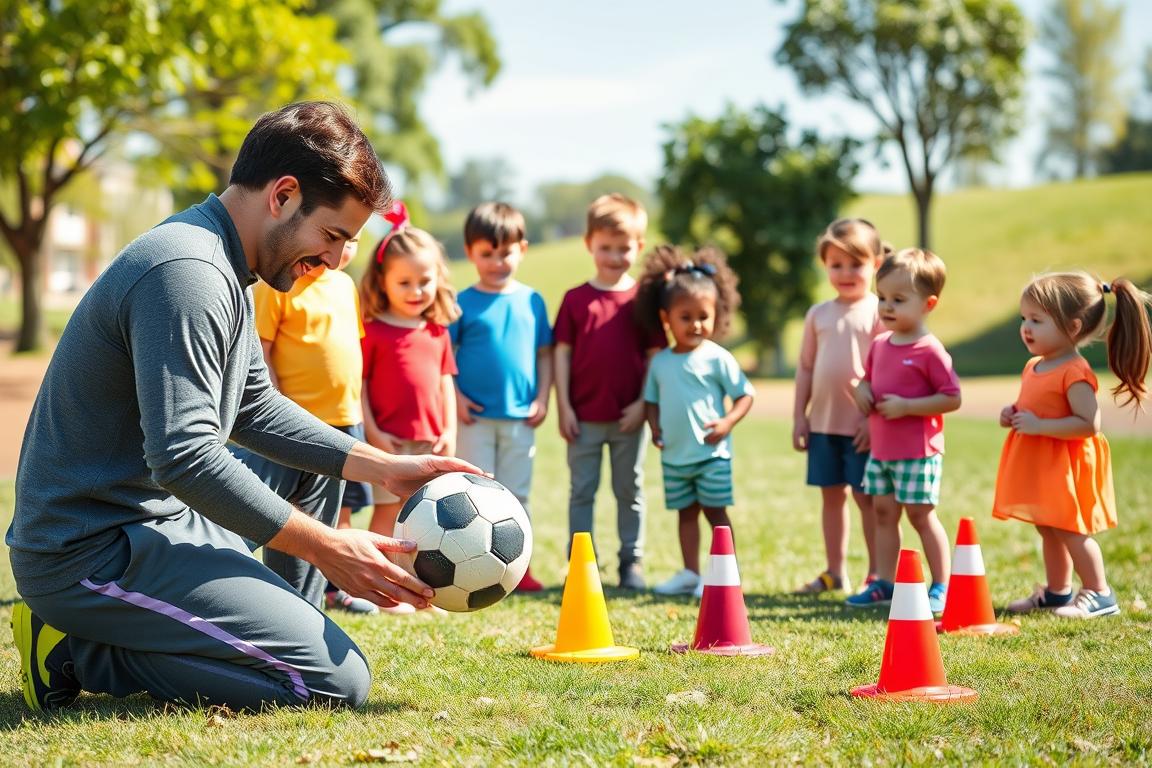
how to introduce soccer rules to kids under 6 is simpler than it sounds. I promise you can help your child enjoy the game, learn one clear rule at a time, and feel confident on the field.
I guide you with short steps that put play first. Start small: tiny fields, soft ball, little goals, and short bursts of play. This keeps attention high and learning fun.
I share simple safety tips, basic coaching moves, and quick plans you can use today. You will see small wins that build confidence and support your child’s development in this sport.
Key Takeaways
- Keep play first: make fun the priority so learning feels natural.
- Use tiny fields and small goals for better engagement.
- Teach one rule at a time and celebrate small wins.
- Bring minimal gear now; add more as skills grow.
- Short games and quick subs match young attention spans.
Start with the goal of the game and a kid-friendly mindset
Start by telling one joyful aim: get the ball into the goal and cheer every try. I keep the message short and clear. This helps young players see the point of the game and want to join in.
Simple aim: get the ball into the goal
Show the goal and point at it. Let each child touch the ball and try a kick. Praise effort fast. I use a single small target each session. That focus helps team play and steady development.
Keep it fun first, rules second
Play comes before strict rule talk. I let kids explore the ball with their feet. Then I add one simple rule at a time. This keeps curiosity alive and learning light.
- One clear message: score and celebrate.
- Short games on a small field make the game obvious.
- Use quick praise and tiny challenges like “stop on my clap.”
- Use show-and-copy: I do, they try.
Set up the play area and gear for the U6 age group
A tidy field and the right gear let young children focus on fun. I keep the layout simple and the gear light. This helps your child feel ready and safe every time they play.
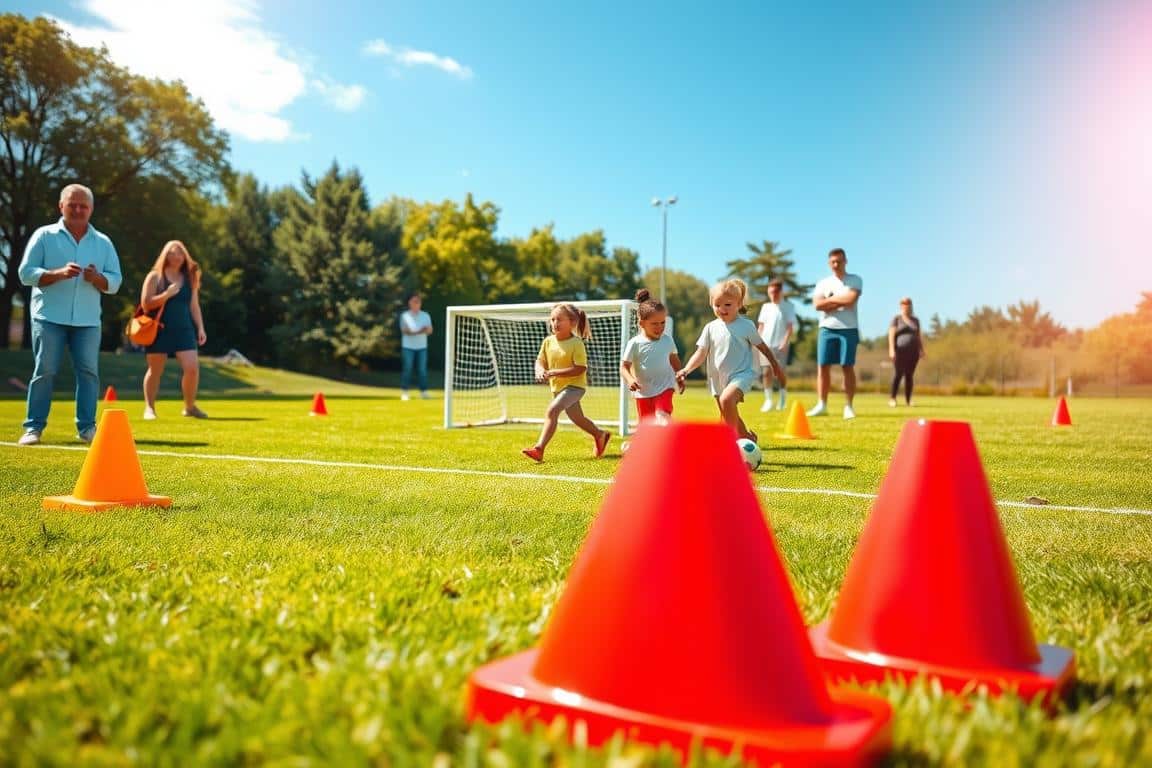
Field size and clear lines
Field: mark a rectangle about 30–50 yards long and 20–40 yards wide. That size keeps players close to the action.
Draw a halfway line and a small center circle. These lines make starts and restarts obvious.
Small, safe goals placed for more scoring
Use four small goals set 3–5 yards in from each corner. This gives more angles and more chances to score. No formal referee is needed; a helper can guide play and keep things friendly.
Ball choice and basic gear
Pick a light, soft size #2 or #3 ball. It moves well for tiny feet and builds confidence quickly.
Put shinguards under socks, lace up athletic shoes or cleats, and keep water on the side. Check the area for holes or rocks before play.
Quick setup checklist
- Bring cones and spare ball so play runs without long pauses.
- Keep team size small and plan short bursts of play with water breaks.
- Set a clear “start here” and “rest here” spot so children know where to go between plays.
| Item | Spec | Why it matters |
|---|---|---|
| Field | 30–50 yds long, 20–40 yds wide | Keeps action close and simple |
| Goals | Small goals, 3–5 yds from corners | More shots, more fun |
| Ball | Size #2 or #3 | Easy for small feet and builds control |
For a quick parents’ resource, see our parents’ guide for extra plans and gear tips.
How to introduce soccer rules to kids under 6
I keep rule talk short and show actions kids can copy. I teach one clear step, then let them play. Quick demos help players learn by watching and copying.
No hands for field players — gentle handball calls
Use your feet first. Tell players that only goalkeepers use hands, but many U6 games skip goalkeepers. If a handball happens, I call it softly and move on.
I explain handball as contact from fingers to upper arm. I say the shoulder can touch the ball and that’s fine. I do not make a big deal unless it keeps happening.
Ball in play, ball out of play — clear lines and simple restarts
I point at the lines and show that the ball is still in play when any part of it touches the line. The ball is out only when the whole ball crosses the line.
When the ball goes out, we restart quickly. The closest player gets ball and passes or dribbles in. Short restarts keep the game moving and reduce waiting.
When a goal counts — the whole ball must cross
Show the goal line and say one sentence: a goal counts when the whole ball goes over the line between the posts. I use a demo with a slow roll so players can see the part that matters.
- Start play at center; pass forward or back so players learn both ways.
- Use cues like “freeze feet” and “go play” to teach rhythm.
- Pause briefly for safety, then restart with an easy pass.
| Rule | Short cue | Why it helps |
|---|---|---|
| No hands | “Use feet” | Builds ball control and clear expectations |
| Ball in play | “On the line, still play” | Teaches boundaries without long stoppage |
| Goal counts | “Whole ball over” | Clear, visual finish for scoring |
Use small-sided teams so every child gets the ball
Small teams mean big chances for every child to touch the ball. I set up 2v2 or 3v3 games without goalkeepers. This makes the game fast and fun.
More touches, more learning
Each player touches the ball more often. Less waiting on the side makes players enjoy play and learn faster.
Quick subs and fair turns
Rotate a player after every goal and when the ball goes out. Use halftime or injury breaks for extra swaps. Keep rosters small so each child gets more time on the field.
- I use two fields when many kids arrive so all players get real games.
- I ask the team to pass once before a shot now and then to build teamwork.
- I keep rounds to two or three minutes to match short attention time.
| Setup | Why | When |
|---|---|---|
| 2v2 or 3v3 | More touches per player | Every session |
| No goalkeeper | More chance to score a goal | All games |
| Quick rotation | Fair play and fresh legs | After goals/out |
I cheer effort like a smart pass or a quick stop. I remind coaches and parents to clap for both sides. That models respect and keeps youth soccer joyful.
Teach core skills with easy steps: dribble, pass, shoot
I keep sessions short and active. My focus is simple: build feet feel, passing choices, and confident shots. Each mini lesson has one clear cue. Then we play and celebrate small wins.
Close control in tight space
Bend the knees and use tiny taps with the inside and outside of the feet.
Keep the ball close. Use toes and heels to nudge the ball while you move. I say “soft taps” and kids copy fast.
Long dribble in open space
Push the ball ahead with the laces, then run after it. This builds speed and space awareness.
Use a few big touches and then look up. That helps with development of vision and quick choices.
Passing with the inside of the foot
Plant the non-kicking foot next to the ball, open the hip, strike with the flat inside, and follow through.
I tell players to look up between touches so passing links play and builds teamwork.
Shooting: control first, power next
Start by treating a shot as a strong pass toward goal. Use the inside for accuracy.
When ready, add laces for power. Cue “ankle locked” and a “big swing” while keeping balance with knees bent.
- I use quick practice bursts: 20–30 seconds on, short rest.
- Simple drills: gates passing, cone slaloms, and short shooting reps.
- Repeat one coaching point each time, like “use the inside,” and celebrate small wins.
| Skill | Key cue | Drill idea |
|---|---|---|
| Close dribble | Soft taps, knees bent | Cone slalom |
| Long dribble | Push with laces | Run-and-chase relay |
| Passing & shooting | Plant foot, follow through | Gate passes; short target shots |
Play simple games and drills kids love
I pick short, playful drills that keep every child moving and smiling. These activities build ball control, quick decision-making, and confidence in tiny steps. Keep rounds brief and switch often so players stay excited.
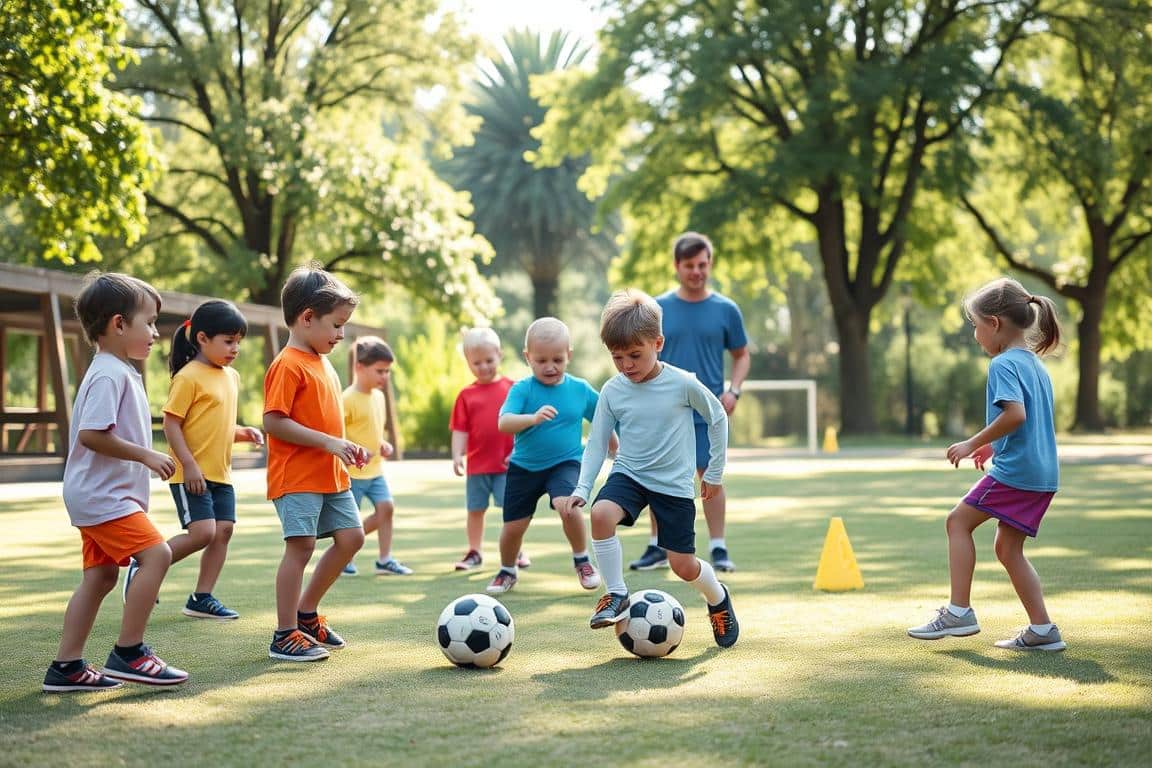
Sharks and Minnows — tight control in traffic
Setup: mark a small square and give each player a ball. One or two adults act as “sharks.”
Action: players dribble while sharks try to tap a ball out. If a ball is tapped, that player becomes a helper shark.
Coach tip: praise close touches and quick shields. Short rounds of 45–60 seconds work best.
Red Light, Green Light — speed and stopping
Setup: line players up with a ball each and an adult as the caller.
Action: dribble on green, stop the ball on red. Add yellow for slow, small taps.
Coach tip: reward clean stops and quick starts. Keep each run under one minute.
Obstacle dribbles and angle shooting
Setup: place cones or toys for a slalom, then set a pop-up goal at the end.
Action: weave using inside and outside touches, then shoot from right, left, and center.
Coach tip: cue inside for accuracy and laces for power. Rotate shooting positions each round.
- Gates passing: pair cones as small goals. Count passes through gates in one minute.
- Relay races: dribble to a cone, turn, and tag a teammate for teamwork and speed.
- Knockout keep-in: keep your ball in a square while others try to knock it out; teaches shielding.
| Game | Setup | Focus |
|---|---|---|
| Sharks and Minnows | Small square, one ball per player, 1–2 sharks | Close touches, shielding |
| Red/Yellow/Green | Line start, one ball each, caller | Starts, stops, control |
| Obstacle + Angle Shooting | Cones/tips slalom, pop-up goal | Turns, inside/outside touches, accuracy |
| Gates Passing | Pairs of cones, partners | Passing accuracy, timing |
Keep rounds short: one minute on, 30 seconds rest. Use tiny fields, minimal lines, and no waiting. Capture short video clips to show progress and smiles. For extra practice plans, try our fun practice ideas.
Keep rules simple: restarts, fouls, and safety
Keep the game simple and safe by teaching just the rules that matter most. I give one short line for each point so players and parents can follow quickly.
Kick-off can go forward or back
At the start, the team may pass the ball forward or back. Everyone stays outside the center circle on their side until the kick-off is taken.
Pass or dribble in when the ball goes out
Restarts are fast: the nearest player passes or dribbles the ball in from where it left the field. This keeps play flowing and reduces waiting time.
No offside, no penalty kicks at this age
Skip offside and penalty kicks so the field stays open. That helps development and keeps players confident near the goal.
No heading; free kicks with six-yard space
Call “no heading” as a safety rule and teach protecting the head. Free kicks are indirect and opponents give six yards of space for a calm restart.
Use a helper “FUN Marshall” to guide and explain
- I stop only when needed, explain in plain words, and give the ball to the other side after a push or trip.
- A FUN Marshall guides players, models fair play, and keeps the tone kind and calm.
- Short halves (10–15 minutes) with a 3–5 minute break match energy and attention.
| Item | Short rule | Why it matters |
|---|---|---|
| Kick-off | Forward or back | Simple start, clear for players |
| Restart | Pass or dribble in | Faster play, less waiting |
| Fouls | Stop, explain, give ball | Safety and quick learning |
I finish each session by praising effort, teamwork, and fun. That keeps youth soccer a positive part of early development and supports ongoing soccer training plans.
Conclusion
End with a tiny, clear plan that makes next steps simple and fun. Pick a small area, set two tiny goals, and run one short game today. Use a size #2 or #3 ball and short halves so every player stays active and smiling.
Try this quick plan this week: five minutes warm-up with a ball each, five minutes of a fun game, five minutes on one skill, then a mini game. Keep teams at 2v2 or 3v3 and rotate often so everyone gets time on the field.
Use short coaching cues like “head up,” “inside of the foot,” and “soft taps.” Praise players by name. Film a brief video of one new move and watch it together to celebrate progress.
Stick with simple rules, kind coaching, and steady practice. That way your child will enjoy the game and build skills one small win at a time.