
Family Soccer Workout Ideas – Fun Together
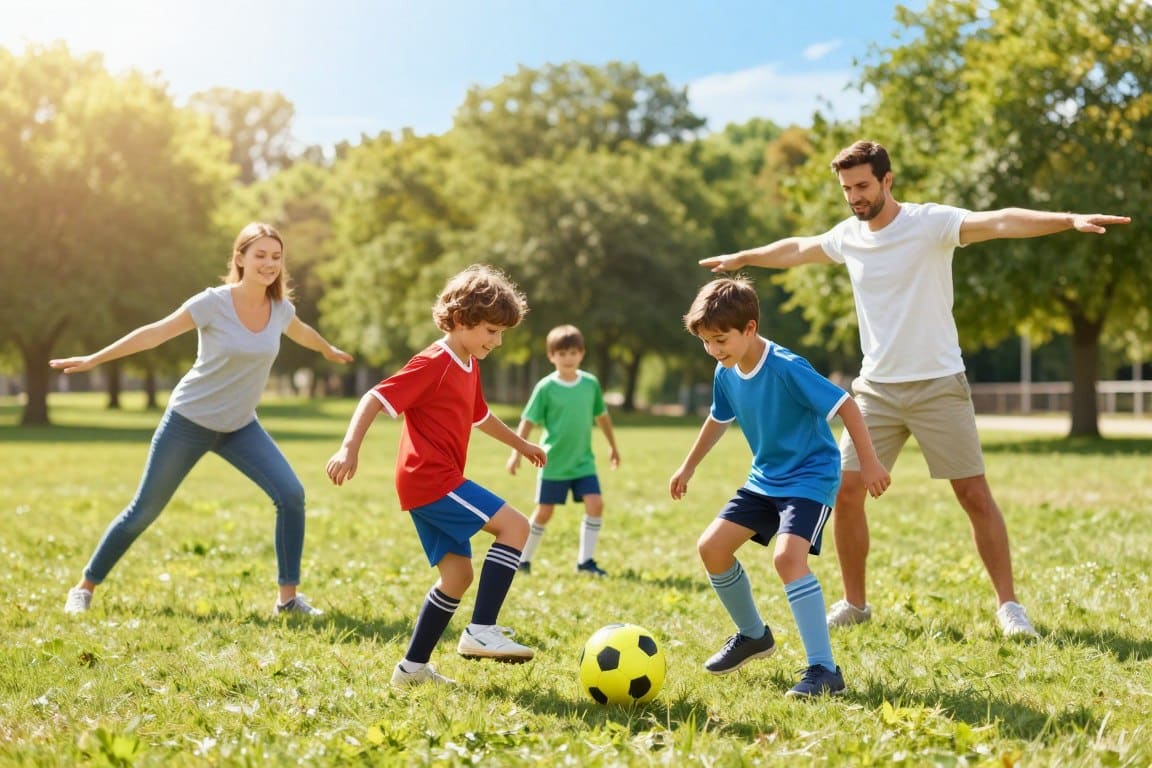
I wrote this to give you simple, game-like sessions you can start today — no full field, no team, no special gear needed.
This guide is for parents, beginner coaches, and energetic kids who want movement that feels like play. Most drills take 15–30 minutes and count toward daily activity goals, so they fit busy lives.
Inside you’ll find warm-ups, ball control, passing, shooting, agility drills, and a small cardio circuit that feels like fun. My measure of success is simple: more smiles, more touches on the ball, and steady progress over time.
I invite you to join in — you’ll keep your child motivated and get some exercise too. Let’s make practice feel like play and build healthy habits one short session at a time.
Key Takeaways
- Quick start: Easy sessions you can do today with little space.
- Designed for parents, beginner coaches, and children age 6+.
- No special gear or full field required — just a ball and open space.
- Short sessions (15–30 minutes) help meet daily activity goals.
- Focus on fun, ball touches, and steady progress — not pressure.
Why family soccer workouts work for kids and parents
Simple at-home practice gives young players extra touches that matter.
Healthy habits and focus
Kids age 6 and up need at least 60 minutes of activity daily (Mayo Clinic). Splitting that into short blocks makes it easier to meet this goal during busy days.
More ball touches, faster progress
Short practice sessions add many more touches than one weekly team session. More reps mean better feel for the ball and fewer wild kicks.
Short drills keep it fun
Quick, game-like drills raise heart rate without boredom. Players stay engaged and learn proper movement across age and skill levels.
- Active kids focus better and sleep better — and you’ll feel better too.
- Every player improves faster with steady reps, even at beginner levels.
- You don’t need coaching experience to run these simple games — I promise.
| Benefit | Short sessions | Weekly team only | Why it matters |
|---|---|---|---|
| Ball touches | High (daily) | Low (weekly) | Improves control and confidence |
| Engagement | High | Medium | Keeps players motivated |
| Fitness | Consistent | Irregular | Supports heart health and skill |
Quick setup for a safe home or park session
A small space and simple gear let you run short sessions fast. Start by clearing a path in a basement, living room, driveway, or on a nearby court.
- Pick a small, clear space and mark boundaries with cones or shoes.
- Do a quick safety check: move lamps, cover sharp corners, and keep pets out of the lane.
- Bring one ball, 3–5 cones or flat discs, and a phone timer.
- Use a timer to keep sessions focused and avoid arguing about “how long.”
For indoor control, try a futsal or lower-bounce soccer ball. It stays closer to the foot and reduces bounce. At the park, a tennis or basketball court gives clean lines and a predictable bounce on any field.
| Option | Best spot | Why it works |
|---|---|---|
| Indoor | Basement or living room | Lower-bounce ball, small space, safe floor |
| Driveway/Court | Tennis or basketball court | Clear lines, even surface, good bounce |
| Park grass | Flat area near goalposts | Soft surface, space for running |
Parent tip: act as the coach with short start/stop cues. Keep instructions simple and positive. Choose a ball size and weight that the child can control easily. For balance and control work, see a short guide on balance exercises.
Warm-up that prepares feet, joints, and focus
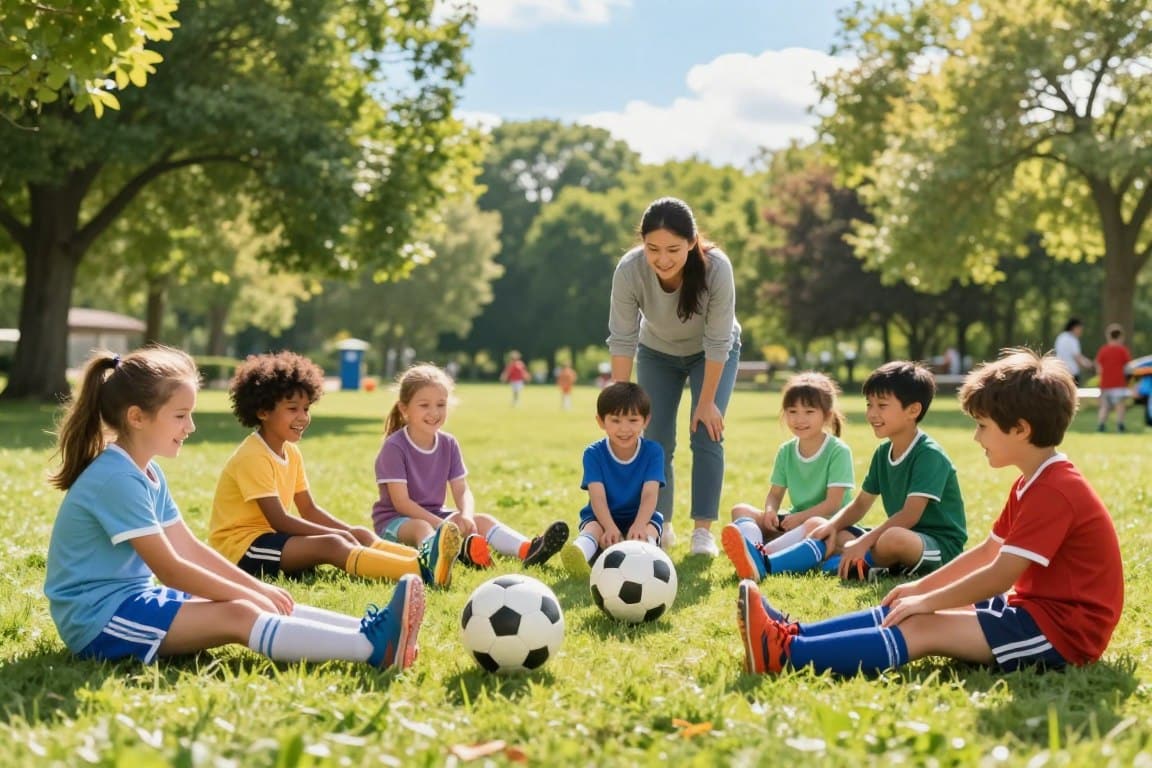
Start with a short routine that wakes up quick feet and bright focus. Keep it simple and playful. Use clear cues and make it a game.
Easy moves that raise body temperature
Do 2–3 minutes of easy movement. Walk, light jog, or march in place. Add a 10-second speed burst at the end.
Simple ball touches to wake up coordination
Move into slow taps, inside touches, and controlled stops. Use toe taps to build speed, balance, and quick feet.
- Joint prep: ankle circles, knee bends, side steps.
- Short cues: “small touches,” “soft knees,” “eyes up.”
- Balance: stand on one foot, then switch.
| Move | Time | Purpose |
|---|---|---|
| Walk or march | 2 min | Raise heart rate and loosen hips |
| Ankle circles & knee bends | 1 min | Prep joints for change of direction |
| Toe taps / inside touches | 2 min | Improve control, foot speed, and coordination |
| Quick steps burst | 10 sec | Build speed and agility before play |
Say it simply: “We warm up so our bodies feel ready and our touches feel smooth.” Make it follow-the-leader and keep smiles high!
family soccer workout ideas for parents and kids that fit into any day
Pick a short block of time and turn it into a fast, focused session that everyone can join.
Set a timer and run a 15–30 minute session. Keep it tight: warm-up, three skill games, a cardio finisher, then a quick cool-down. This plan works on busy days and still builds real skill.
Set blocks in seconds
Use short work/rest cycles like 30 seconds work, 20 seconds rest. Repeat each game 3–5 times. Short bursts keep heart rate up and touches clean.
Rotate roles
Let each player lead one drill. Give the leader one simple cue, then play. Rotating keeps interest high and builds confidence.
Keep score with a fun point system
- 1 point per clean rep.
- Bonus point for weak-foot attempts.
- Team goals like “100 clean passes” make it cooperative and motivating.
Coaching tip: give one cue at a time. Praise effort, not perfection. Use rest times to correct one thing quickly so kids stay safe and touches stay sharp.
| Session part | Time | Purpose |
|---|---|---|
| Warm-up | 3–5 min | Prepare joints and feet |
| Skill games | 10–15 min | Repetition and fun |
| Cardio finisher | 2–5 min | Raise heart rate and end strong |
Ball control and dribbling games for tight spaces
Tight-space ball play builds control fast — no field needed. Use small touches and keep the pace slow at first. Then add speed once control is steady.
Cone dribbling pattern
Set 3–5 cones about one foot apart. Weave through using inside-of-foot touches. Start slow, then time the run and try to beat the score without losing the ball.
Push-pull control
Roll the ball toe-to-heel, then pull it back. Do the drill on both feet. Focus on smooth rolls, not speed.
Toe taps
Alternate toes on top of the ball. Keep chest up for balance. This builds speed and quick feet.
Red light / Green light
On “green” dribble forward. On “red” stop the ball with the sole. This trains reaction time and stopping control.
Weave dribbling
Run a simple left, right, left, right pattern around cones. Aim for sharp, low touches to train quick changes.
- Tight space rules: small touches, slow first, then faster.
- Praise control first: reward steady control before speed so the player stays confident.
| Drill | Setup | Goal |
|---|---|---|
| Cone dribble | 3–5 cones, 1 ft apart | Control through tight gaps |
| Push-pull | Open spot, both feet | Toe-to-heel mastery |
| Red/Green | Short lane | Reaction & stopping |
Passing drills that build touch, accuracy, and teamwork
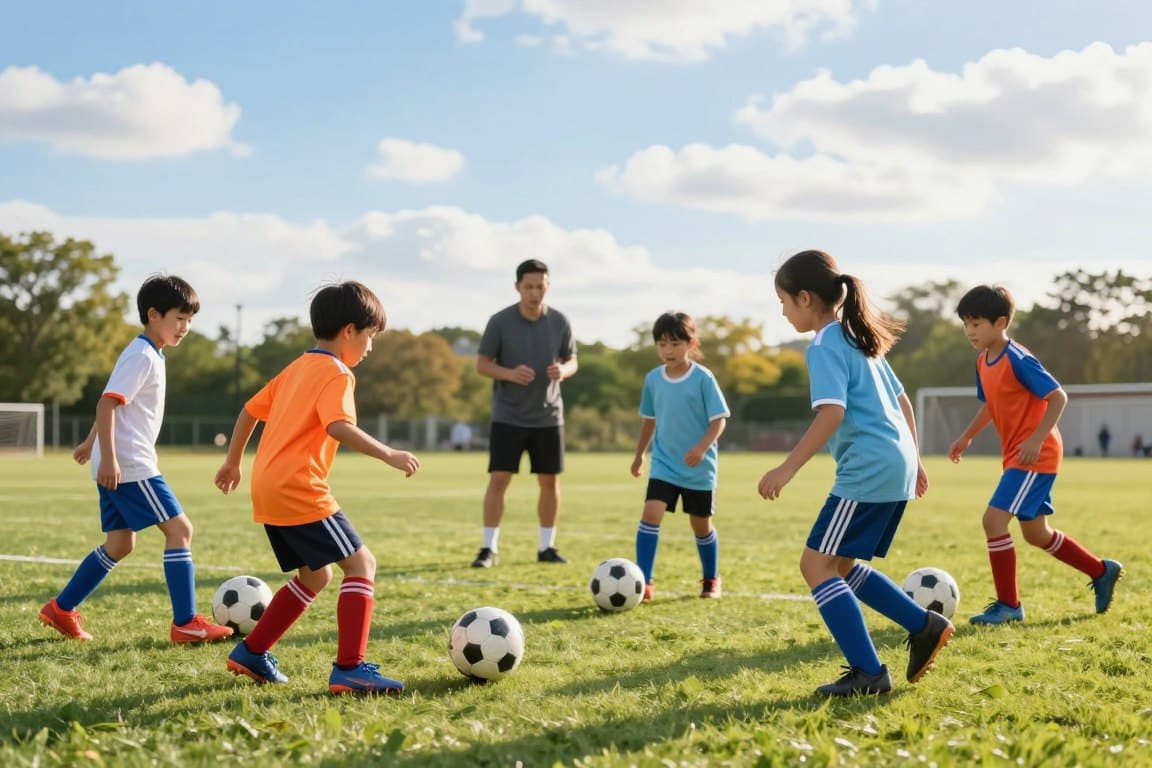
Passing is the quickest way to build touch, control, and shared rhythm during short sessions. Keep the drills simple, repeatable, and fun. Use a clear cue and a short timer to keep energy high.
Pass through a cone lane with a partner
Set two straight lines of cones to make a narrow gate. Stand at each end and pass the ball back and forth for 5–10 minutes.
Coaching cue: “toe up, ankle firm, push the ball to your partner.” Make it harder by narrowing the lane, stepping back, or speeding the passes.
Wall passing challenge
Pass to a wall and receive the rebound with control, then pass again. Use a 30-second timer or count clean passes before the ball bounces twice.
This trains pace and first touch in a simple, repeatable way.
Weak-foot passing
Finish a round using the weaker foot only. Ten to thirty passes builds two-foot ability and boosts real-game confidence.
Tie it to teamwork: track clean passes together and celebrate steady progress.
- Short sets: 5–10 minutes per drill.
- Keep cues simple and praise effort.
- Rotate who leads the drill to build communication.
| Drill | Setup | Goal |
|---|---|---|
| Cone lane | Two lines of cones, partner at each end | Accuracy through a narrow gate |
| Wall pass | Wall or rebound surface, 30s rounds | Pace and first-touch control |
| Weak-foot round | Same drills using weaker foot | Two-foot ability and confidence |
Shooting practice that feels like a game
Turn a few cones and one ball into a fun target zone that trains aim and balance. I like drills that copy real moments from the field so players learn timing and choice.
Cone goal with a playful goalie
Set two cones about 4–6 feet apart to make a mini goal. Pick a safe shooting line away from windows or cars.
Have the parent act as goalie and keep it light. No diving hard—make saves with hands and smiles.
Penalty-style starts and dribble-then-shoot
Begin with simple stationary shots. This teaches clean contact and balance.
Then add dribble-then-shoot: take 3–5 dribble touches and finish. That copy of a real game moment helps decision-making and timing.
Call the shot and train both sides
Use quick call-outs: say “left,” “right,” or “middle.” The player aims at the named side. It trains aim under a small cue.
Do sets on the weaker side too. Weak-foot shots build confidence on both sides of the body.
- Keep it safe: choose a clear line and soft surface.
- Points game: 2 points for a called-shot hit, 3 points for a weak-foot goal.
- Celebrate effort: praise technique and bravery, not just goals.
| Drill | Setup | Goal |
|---|---|---|
| Cone goal | 2 cones, 4–6 ft apart; safe line | Aim and accuracy under simple pressure |
| Penalty-style | Stationary ball, short run-up | Clean contact and balance |
| Dribble then shoot | 3–5 touches then finish | Timing, speed control, game realism |
| Called-shot rounds | Coach calls left/right/middle | Targeting and quick decision-making |
Agility, speed, and coordination add-ons for the whole team
Try short, focused movement drills that boost reaction and timing. These extras fit after ball work or stand alone on busy days.
Quick-feet races: set a 10–20 second burst and sprint to beat the last score. Use toe taps and fast resets to train both feet.
Quick-feet races that use both feet and short bursts
Count down and go — 10 or 15 seconds is perfect. Keep steps small and light. Hop steps, quick steps, and toe taps build balance and speed.
Side-to-side movements that train change of direction
Shuffle across a short line. Face forward, move side-to-side, then stop with soft knees. This trains cutting and quick turns safely.
- Use both feet on purpose — alternate leads each run.
- Scale by age: shorter bursts for younger players; longer for older ones.
- Stop the drill if form breaks, rest, then repeat.
- Make it a team score: total runs and try to beat last week together.
| Drill | Setup | Goal |
|---|---|---|
| 10–20s quick-feet | Short lane, timer | Improve speed and reaction |
| Toe-tap resets | Stationary spot, 3 reps | Build quick feet and balance |
| Side shuffles | 3–5 yards line | Train change of direction |
Coach tip: keep it upbeat and safe — soft knees, small steps, and controlled stops. Faster feet help players react and get into space during practice and games.
Cardio circuit training to keep conditioning year-round
Use a timer, five moves, and a little friendly competition to boost fitness. This circuit takes 10–20 minutes and fits into busy days.
Ready-to-use circuit:
- High knees — 30–60 seconds
- Butt kicks — 30–60 seconds
- Jumping jacks — 30–60 seconds
- Burpees — 30–60 seconds
- Alternating foot hops — 30–60 seconds
Timing and rest: Rest 20–40 seconds between moves. Repeat 2–4 rounds based on age and levels.
- Good effort = steady breathing, safe landings, and controlled form.
- Young players do fewer rounds and longer rest. Older or fit players add rounds or speed.
- Track progress on a whiteboard or phone app — write rounds, best time, or total reps.
- I recommend parents join in to raise effort and keep it fun.
| Player level | Rounds | Rest |
|---|---|---|
| Beginner (younger age) | 2 | 30–40 seconds |
| Intermediate | 3 | 25–35 seconds |
| Advanced | 4 | 20–30 seconds |
Soccer tie-in: This circuit builds speed, stamina, and agility so players stay ready in the off-season and during the season.
Finish with a one-minute cool-down: walk, shake legs out, and breathe slowly. For extra strength tips, see these strength and conditioning tips.
Conclusion
A short, simple plan helps every player build confidence with the ball. Set up a small space, warm up, run a few skill games, then finish with a short circuit. Repeat often — repetition builds comfort and keeps heart rate up.
Next step: pick two drills and do each three times this week. Mix one dribbling game, one passing drill, and a shooting challenge to cover all the bases toward a clear goal.
Make weak-foot work a tiny habit. A few minutes of that each session boosts passing and shooting confidence in real game moments. Keep score on a simple board to make play friendly and motivating.
You don’t need perfect drills — just show up, move, and enjoy the time together. I promise progress comes from consistency and fun, not pressure.