
Fun Agility Ladder Drills for Youth Soccer

I promise simple, playful practice that builds quick feet and steady balance. The phrase fun agility ladder drills for youth soccer says it all: short sessions, clear goals, and easy progress for ages 3–12.
Start with a short setup and safety check. I explain what an agility ladder is and how it fits into calm practice. Most blocks last 10–20 minutes and mix short hard reps with easy rest.
You can scale each move by slowing the pace or shortening the rung set. Use cones or chalk if you do not own a ladder. The aim is simple: faster feet, better coordination, and improved control — all without pressure.
Key Takeaways
- Short sessions (10–20 minutes) work best for young kids.
- Scale each exercise by speed or ladder length.
- Focus on balance, coordination, and quick footwork.
- No ladder? Use cones or chalk as a substitute.
- Stop while form is good — keep practice positive.
What agility ladder training does for youth soccer players
This work builds faster feet, better balance, and cleaner touches in small bites. I keep sessions short and simple. Kids learn one idea at a time.
It builds quickness, coordination, and balance
Quickness means you react faster and move feet faster. Coordination is when feet and arms work together so kids trip less. Balance helps players stay steady when they land or turn.
It supports speed changes like accelerate, decelerate, and cut
Better footwork lets players accelerate, slow, and change direction without falling or drifting wide. This training improves speed and movement quality in play.
It helps players control body position for better ball control
Good posture and core control keep hips and chest steady while feet move. That makes touches cleaner and passing more consistent.
- Progress shows as fewer rung hits, quieter landings, and cleaner stops.
- The ladder does not replace ball work; it helps improve movement and control.
| Benefit | What it means | How you see progress |
|---|---|---|
| Quickness | Faster reactions and steps | Faster starts, fewer mistakes |
| Coordination | Feet and arms sync | Smoother runs, less tripping |
| Balance | Stable landings and turns | Controlled stops, cleaner touches |
Set up the agility ladder and teach safe movement
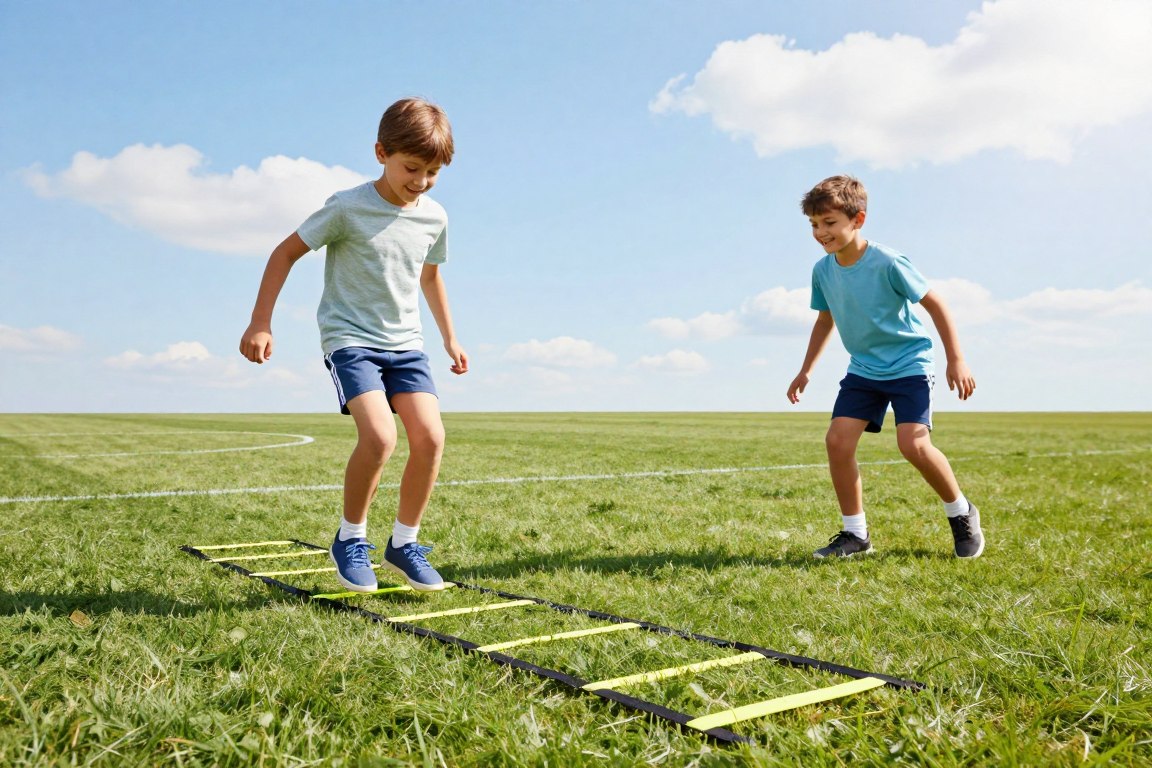
- Lay the ladder flat. Remove wrinkles and secure ends with cones. Mark a clear start and end.
- Line kids up to the side so you can see each foot and every rung.
- Tell them the safety rule: step in each square. Slow down if a foot clips a rung.
Simple coaching cues
- Eyes forward — quick glance down only.
- Elbows at 90 degrees; small arm pump with each step.
- Push off the balls of the feet. Land light and quiet.
- Slight forward lean — weight over the toes, not bent at the waist.
Work-rest and rules
Try 10–15 seconds on, 30–45 seconds off. Run 2–4 rounds and stop when form breaks.
| Focus | What to watch | Why |
|---|---|---|
| Placement | Step into every square | Reduces trips and teaches control |
| Arms | 90° elbow bend | Helps rhythm and balance |
| Feet | Quiet landings | Protects legs and keeps pace |
Warm-up ladder drills that teach fast feet
Begin with light moves that tune feet and focus before harder patterns. Warm-up ladder drills wake up quick reactions and prepare the body for more intense work.
One Step — quick foot speed in every rung
Start position: stand at the first rung, feet hip-width, arms bent.
Steps: one foot in each rung, light pick-up, steady pace.
Coaching cue: keep elbows bent and pump arms in rhythm.
Two Step — add rhythm and coordination
Start position: face the ladder, ready to step into the first square.
Steps: place both feet inside each rung before moving on — “tap-tap, move.”
Coaching cue: head up and keep a steady tempo to learn spacing.
Side Step — train lateral movement both directions
Start position: face sideways to the ladder. Lead foot near the first rung.
Steps: step lead foot, then trail foot into each box. Repeat back the other way so both sides get the same work.
Coaching cue: small steps, quick exits — control the side movement.
- Why first: these drills prime feet and focus before harder patterns.
- Warm-up dose: 1–2 runs per drill keeps attention and builds speed safely.
fun agility ladder drills for youth soccer that kids ask to repeat
Kids love this set — short, clear moves that still teach control. I call it the “fun block” because it keeps attention while building real skills.
Jumping Jacks
Step 1: two feet jump inside the rung. Step 2: land with both feet outside the next rung and raise arms.
Safety cue: land soft with knees slightly bent.
Hopscotch
Pattern: jump in (two feet), jump out (two feet). Repeat fast with precise landings.
Why it helps: trains explosiveness, quick stops, and sharp change of direction.
Five Hops and Run
Count: hop 1-2-3-4-5, land both feet on five, then run one step per box.
Key point: land together on five before the run to keep control.
Side Straddle Hop
Use an “in-out, in-out” rhythm. Arms at 90°. Keep feet quiet — no slapping.
- Repeat game: kids pick one move and try to do it cleaner, not just faster.
- I encourage short rounds and positive praise at the end of each run.
| Drill | Main benefit | Coaching cue |
|---|---|---|
| Jumping Jacks | Coordination & strength | Soft landings, arms up |
| Hopscotch | Explosiveness & direction change | Quick, precise jumps |
| Five Hops & Run | Transition speed & control | Stick landing on 5 |
| Side Straddle Hop | Lateral timing & balance | In-out rhythm, quiet feet |
Lateral and change-of-direction ladder drills for game movement
Side movement matters in matches. Short sideways patterns teach cuts, recovery, and steady balance.
Lateral High Knees
Start sideways at the first square. Lift the knee to waist height, place the foot in the square, then the other.
Cue: keep hips level. Repeat starting with the opposite lead leg. Do both sides.
Lateral In and Out
Stand beside the side ladder. Tap both feet in the square, then both feet outside. Move down the line fast.
Cue: quick taps, clean exits. Rest ~30 seconds between sets if kids need it.
Crossover
Begin facing sideways with the nearest foot leading. Step over the lead leg so one foot lands in each square.
Cue: step over, don’t swing the leg wide. Repeat both directions so right foot and left foot lead.
Carioca and Centipede
Carioca uses the pattern “crossover, return, behind.” Arms stay bent at 90° to help rotation.
Centipede runs along the edge of the ladder with quick, precise steps — no big hops. These patterns improve control and footwork.
| Drill | Start | Main cue | Do both sides |
|---|---|---|---|
| Lateral High Knees | Side of ladder | Hips level, knee to waist | Yes — right & left |
| Lateral In and Out | Beside first square | In-in, out-out taps | Yes — switch lead |
| Crossover | Side-on, lead foot ready | Step over, small swing | Yes — swap lead foot |
| Carioca / Centipede | Edge of side ladder | Rotate hips, quick precise steps | Yes — both directions |
Advanced footwork patterns that improve agility and control
I show simple counts to make tougher step sequences easy to teach. Start slow and only add pace once form is steady.

Ickey Shuffle — “in, out, up”
Teach the Ickey Shuffle with the three-count: in, out, up. Say the words out loud with kids. Cue: stay light on your feet and keep the chest steady.
Backwards Ickey Shuffle
Same pattern in reverse. This trains backpedal movement defenders use. Go slow and keep knees soft.
Single Leg Shuffle
One leg taps inside the square while the outside leg travels straight. Repeat on the right foot and left foot to balance work.
In & Out, Double Trouble, Speed Scissors
In & Out uses a four-count: in, in, out, out. Keep steps small to avoid hits.
Double Trouble follows the same count but with full-square hits on every touch. Learn the pattern, then build speed.
Speed Scissors: jump low, switch legs like scissors and land steady before the next switch.
- I set the tone: “advanced” means new pattern — slow first.
- Add the ball later: once feet are clean, finish runs with a short dribble to boost ball control.
| Drill | Count | Main cue |
|---|---|---|
| Ickey Shuffle | In, Out, Up | Light feet, chest steady |
| In & Out | In, In, Out, Out | Small steps, neat exits |
| Double Trouble | In, In, Out, Out | Full-square hits, controlled speed |
| Speed Scissors | — | Low jump, quick switch |
Conclusion
Keep it simple and steady. Ladder drills build quickness, coordination, and balance that show up in real soccer movement. I recommend short blocks — 10–20 minutes — to keep players sharp and smiling.
Try this week: 3 warm-up moves, 2 playful patterns, and 1 lateral exercise. Stop when form drops. Start once a week and move to two or three sessions as legs and focus improve.
Top cues: light feet, small steps, arms pump, and eyes forward with quick checks on the rung. Track progress by fewer rung hits, cleaner stops, and steadier balance on one foot.
Finish with a quick sprint or a short dribble to tie footwork to the ball. For extra tips on how to improve soccer footwork, see that guide.
I’m here to help — keep it simple, keep it positive, and the players will keep getting better.