
Effective Soccer Practice Drills for Kids – A Guide

Watching your child light up with joy while mastering a new skill is one of the best feelings. I believe the right soccer practice drills for kids can turn that spark into a lasting love for the beautiful game.
The secret is simple. Young players learn best when they’re having a blast. The most effective activities put them on the field, give them a ball, and spark their imagination.
This guide is for you—the parent or new coach who wants to help. You don’t need to be an expert. I’ll show you how structured play builds fundamental techniques while keeping everyone engaged and smiling.
We’ll focus on building confidence through games that teach dribbling, passing, and shooting. For example, focusing on how to improve soccer footwork can be woven into fun, competitive races.
Key Takeaways
- The best learning happens when children are having fun and fully engaged.
- Effective activities combine skill development with imaginative play.
- These methods work for various ages and different skill levels.
- Building a player’s confidence is just as important as teaching technique.
- Parents and new coaches can successfully guide young children.
- Fundamental skills are best learned through activities that feel like games.
- A little structure goes a long way in creating a positive experience.
Why Fun Soccer Drills Matter
The connection between fun and skill development in youth sports is powerful and undeniable. Children between five and twelve years old are in a golden age for learning. Their brains and bodies absorb new movements best when they’re engaged and happy.
Building Confidence and Skill
I’ve seen it firsthand. When a child enjoys the activity, they try harder things without fear. They build confidence naturally. This confidence lets them master new techniques faster.
Laughter and play lower stress. In this state, young players perfect footwork and ball control almost without realizing it. The skills stick because they were learned through joy.
| Aspect | Fun-Focused Approach | Pressure-Focused Approach |
|---|---|---|
| Player Engagement | High – children are excited and involved. | Low – can lead to boredom or anxiety. |
| Skill Acquisition | Faster – learning feels like play. | Slower – fear of mistakes hinders progress. |
| Long-Term Motivation | Strong – builds a lasting love for the game. | Weak – can lead to burnout or quitting. |
Creating a Positive Learning Environment
A positive environment breaks down barriers. Teammates and coaches connect more easily. Children feel safe to experiment and make errors.
This supportive space keeps players motivated. They understand instructions better. Most importantly, they develop a genuine love for the game that can last a lifetime.
Soccer practice drills for kids
When activities have a clear purpose, children engage more deeply and learn faster. The secret is mixing fun with smart repetition. This approach keeps each session fresh and exciting.
Young athletes improve their abilities without boredom. They look forward to training because it feels like play. I see this create lasting progress every time.
Key Benefits of Structured Drills
Structured exercises give your child a clear path forward. They build confidence through consistent, achievable steps. This method turns confusion into mastery.
You will notice faster skill development. Repetition within fun activities locks in muscle memory. Young players perfect dribbling, passing, and shooting almost without thinking.
Your team learns to communicate and coordinate better. Organized sessions prepare them for real game situations. They understand where to be and what to do.
This framework also prevents burnout. It introduces variety within a reliable routine. A great way to add energy is with soccer fitness games for kids.
Ultimately, structured drills build a love for the game. They combine focus with creativity. Everyone leaves the field feeling successful and eager to return.
Effective Warm-Up Drills
I like to kick off every practice with activities that get hearts pumping and smiles growing. Proper warm-ups prepare young athletes’ bodies for action. They also reduce the risk of injuries during more intense exercises.
Simple Activities to Get Started
I always begin with light running games that don’t use a ball. This gets players moving and focused. It builds energy for the skills we’ll practice later.
These initial games create a fun atmosphere. Everyone laughs and engages right away. The coach can join in to make it even more exciting.
Examples: Fox Tails and Hospital Tag
Fox Tails is a favorite chase game. Each player tucks a cloth into their shorts as a “tail.” The goal is to grab others’ tails while protecting your own.
Set up a small area about eight yards square with cones. Players learn to think about offense and defense simultaneously. This drill builds athleticism and spatial awareness.
Hospital Tag adds a creative twist. Mark a ten-yard square play area. Players place their balls outside the boundary before starting.
When tagged, a player places one hand on the touched body part. After three tags, they “go to the hospital” by dribbling their ball with five controlled touches. This variation trains speed, reflexes, and quick thinking.
| Drill | Primary Skills | Equipment Needed | Space Required |
|---|---|---|---|
| Fox Tails | Athleticism, awareness, defense/offense thinking | Cones, cloth strips or socks | 8×8 yard area |
| Hospital Tag | Speed, reflexes, strategy, ball control | Cones, soccer balls | 10×10 yard area |
Both activities require minimal equipment. They work well in small spaces with light running. These warm-up drills make learning feel like play.
Dribbling Drills to Build Control
Ball control starts with simple, repeatable movements that build confidence. This core skill lets young athletes navigate the field with assurance. I focus on activities that teach light, controlled touches.
Repeatable Moves for Ball Mastery
Begin with stationary exercises. They create a strong foundation for all other skills. For example, Toe Taps get players comfortable with the ball.
Your child taps the top with the sole of each foot. Another great one is called Foundations. Here, athletes move the ball side-to-side using the inside of both feet.
The Inside/Outside Touch drill adds variety. It combines different parts of the foot for better command.
| Drill Name | Primary Focus | Key Movement | Benefit |
|---|---|---|---|
| Toe Taps | Comfort & Rhythm | Alternate tapping ball top with soles | Builds initial touch and balance |
| Foundations | Ball Familiarity | Rolling ball between feet with inside touch | Teaches keeping the ball close |
| Inside/Outside Touch | Foot Dexterity | Inside touch, then outside touch of opposite foot | Develops versatile ball control |
Once the basics feel good, add movement and games. Snake in the Grass makes learning fun. Participants dribble to avoid “snakes” on the ground.
Red Light Green Light is another favorite. It teaches changing speed and stopping on command. These soccer drills turn essential techniques into playful challenges.
Passing Drills for Team Building>
Great teams are built on the simple act of moving the ball together. Keeping possession is essential for scoring and winning. I focus on activities that teach young athletes how to share it effectively with teammates.
Techniques to Improve Accuracy
Good passing relies on angle, pace, and timing. I start with simple two-player exercises. Your child learns to control the ball with one foot and pass it with the other.
From there, we build to group activities. The Triangle Combination drill uses three cones. Players stand outside each cone and pass in sequence, then move to the next spot.
This teaches combination play under pressure. Everyone must communicate and support each other. It turns a group into a coordinated team.
| Drill Name | Players Needed | Primary Focus | Key Benefit |
|---|---|---|---|
| Triangle Combination | 4 | Angle & Timing of Passes | Builds movement off the ball |
| Passing & Trapping | 2 | First Touch & Return Pass | Develops quick, accurate exchanges |
| Rondo (5 v. 2) | 7 | Possession Under Pressure | Improves shielding and support |
| Gates Passing | Small Groups | Aiming for Targets | Enhances accuracy and communication |
These exercises make a real difference. Teams that practice passing together develop better possession. They learn when to pass and when to dribble, which wins games.
Shooting Drills to Enhance Scoring
The ability to shoot accurately and confidently is what turns a good player into a game-changer. I teach young athletes that this skill is fundamental for everyone on the field. Scoring a goal is how you win matches.
Start with a simple setup. Place a cone about 10-15 yards from the goal. Your child begins at that cone. You then pass the ball toward the net, creating a breakaway chance.
The player must chase it down and score with one or two touches. This mimics the fast pace of a real match. It trains them to pounce on opportunities quickly.
As consistency improves, add creative restrictions. Limit the number of touches before shooting. Or require aiming for specific corners of the goal.
These challenges make players more fluid. They learn to find space and place the ball where the goalkeeper can’t reach it. The goal is to make shooting feel natural and instinctive during games.
Age-Specific Drills for Growing Players
A five-year-old’s needs on the pitch are very different from those of a nine-year-old. I match activities to a child’s developmental stage. This keeps them engaged and builds skills without frustration.
Drills for Young Beginners (4-5 Years Old)
Young players at this age are building coordination. Their attention spans are short. Keep sessions positive and basic.
Cone Chase is perfect. Divide your group into two lines. Call out numbers, and players race to grab the empty cone. It teaches listening and quick reactions.
Another great game is Pac Man. Everyone dribbles along marked lines. One player, the “Pac-Man,” chases and tags others. It makes dribbling feel like a fun challenge.
Activities for Older Kids (6-9 Years Old)
As children grow, they can handle more complex rules. They also start enjoying competition. Progress to activities that combine multiple skills.
For six-year-olds, try Sharks and Minnows. “Minnows” dribble across a grid while “sharks” try to steal the ball. It’s an exciting game of keep-away.
Seven-year-olds love Pirates of the Pugg. Players dribble in a circle while “pirates” tackle and try to score on a small goal. It mixes dribbling, defending, and shooting.
By ages eight and nine, introduce simple strategy. First Pass 1v1 starts with a pass, then a one-on-one duel. 4v4 to Mini-Goals rewards specific types of passes, teaching team play.
| Age Group | Drill Name | Primary Focus | Key Skill |
|---|---|---|---|
| 4-5 Years | Cone Chase | Listening & Reaction | Agility |
| 4-5 Years | Pac Man | Dribbling Control | Ball Familiarity |
| 6-7 Years | Sharks and Minnows | Possession Under Pressure | Shielding the Ball |
| 6-7 Years | Pirates of the Pugg | Combined Skills | Tackling & Shooting |
| 8-9 Years | First Pass 1v1 | Passing Accuracy & Dueling | One-on-One Attack |
| 8-9 Years | 4v4 to Mini-Goals | Team Strategy | Passing for Points |
Start with the best soccer drills for their age. Move to harder ones as they master the basics. This approach builds a strong foundation in youth soccer.
Coaching Tips for Successful Practice Sessions
Effective coaching hinges on balancing structure with creativity during each session. Your main job is to guide players while keeping the atmosphere light and enjoyable. I focus on creating a plan that feels organized but leaves room for fun.
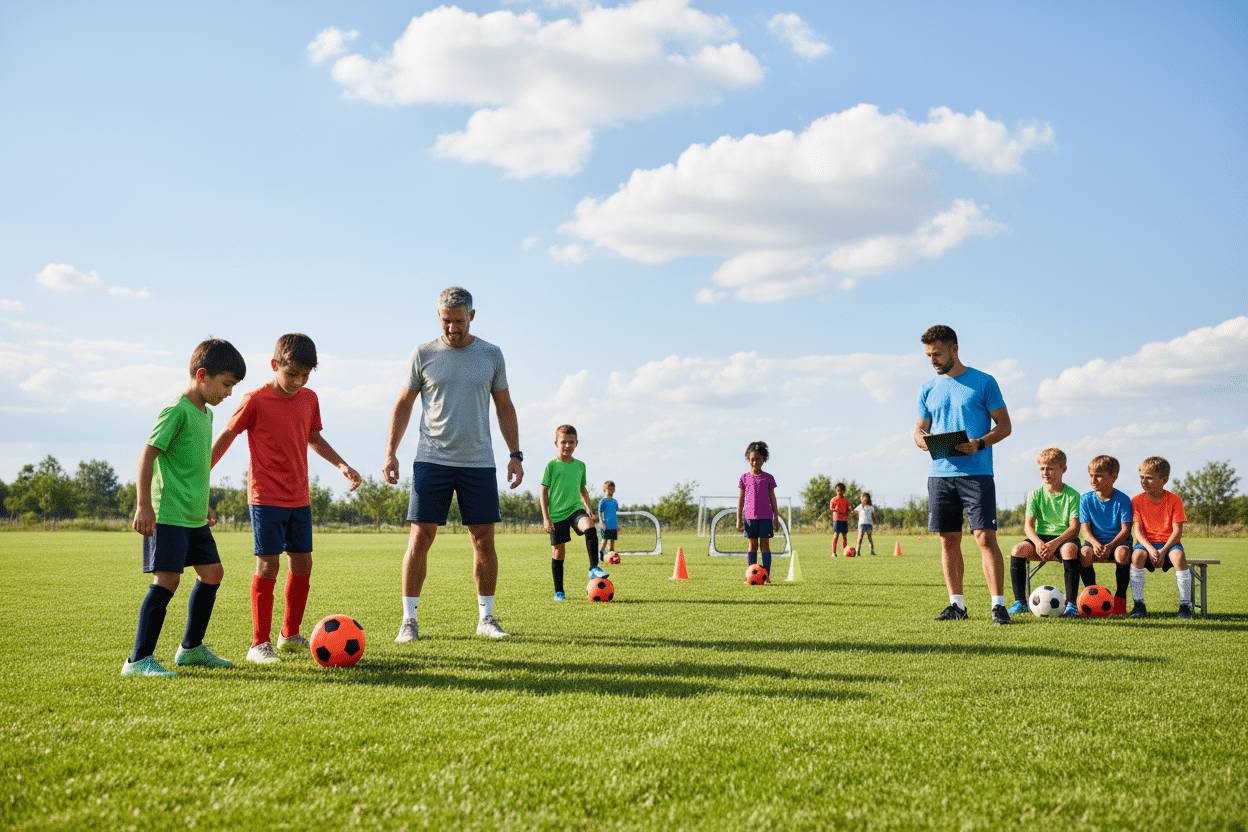
Great soccer practice sessions blend clear instruction with playful energy. This approach helps young athletes learn faster and stay motivated. Let’s explore how to keep everything running smoothly.
Keeping Sessions Fun and Focused
Always start slowly. Let your players work into each drill at their own pace. This builds comfort and prevents frustration.
Stick to the basics. Even the best soccer professionals practice fundamental soccer skills every day. Repetition of simple movements builds a strong foundation.
Provide simple, constructive feedback. Correct techniques gently to avoid ingraining bad habits. Your words should build confidence, not create pressure.
Progress to more difficult drills when the current ones become easy. Players get bored if you underestimate their abilities. Challenge keeps them engaged.
Use the right equipment. Size 3 balls, cones, and small goals are perfect for young athletes. A large grassy field gives everyone enough space to move.
Try creative activities like Half-Court Soccer. This game is inspired by basketball and shrinks the playing space. It teaches team attacking and defending in tight areas.
Another favorite is Space Wars. Here, the coach plays the villain and flops dramatically when kids hit a target. It adds drama while teaching dribbling and short passes.
When you divide players into two teams, they learn healthy competition. The recipe for a great practice is simple. Put your players on the field, give them a ball, and spark their imagination. Let them learn by doing.
Conclusion
The journey from beginner to confident player is filled with small, joyful victories. You now have a complete set of activities to guide that journey.
Each soccer drill in this guide builds a specific skill. Young players need consistent, enjoyable repetition. This is how comfort with the ball grows.
Remember, progress takes time. Do not expect instant mastery. Your patience and regular sessions will bring results.
Keep the atmosphere light and fun. This is how kids develop a real love for the soccer game. These foundational soccer drills give every child the tools to succeed.
Start with one simple activity today. Watch their confidence bloom.