
Fun Indoor Soccer Fitness Games for Kids
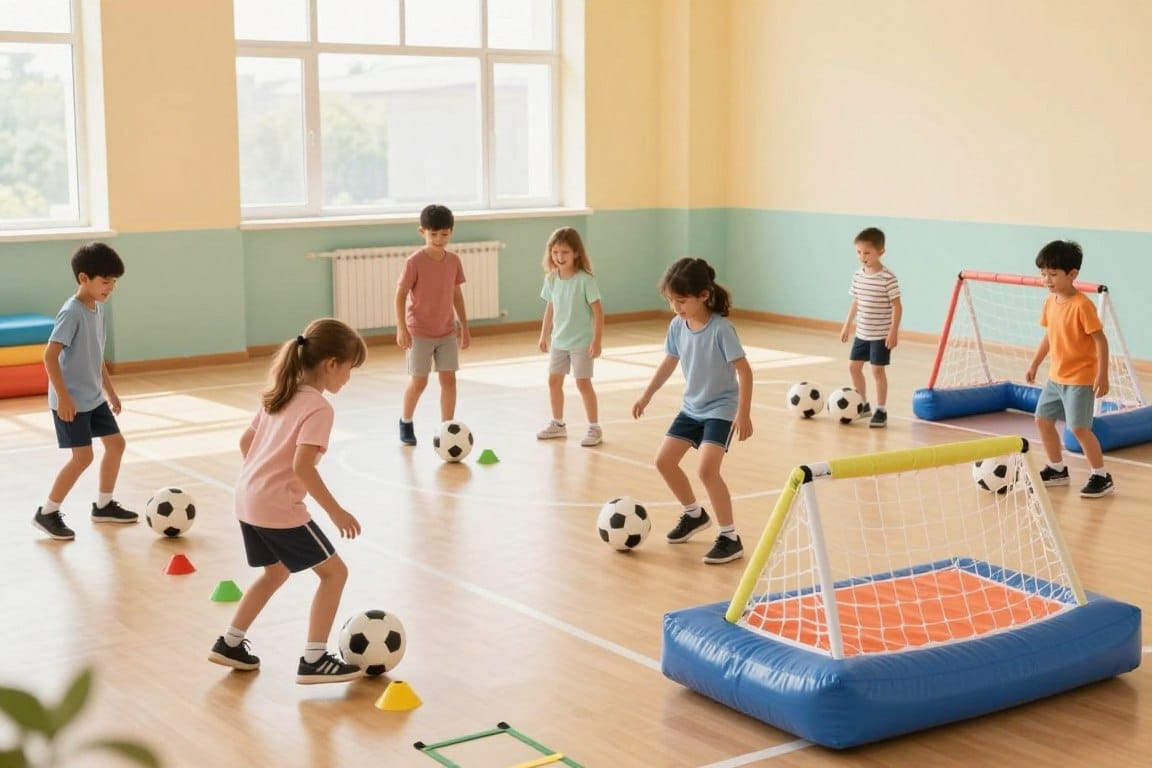
I know how a sudden downpour shifts practice into the living room, and I also know that fun soccer fitness games for rainy days can keep energy high and moods bright. This short set of ideas turns tight spaces into playful drills that boost touch, balance, and heart rate without wrecking lamps.
Quick wins: I give simple safety tips first, use items you already own, and show ways to scale each activity for ages 3–12. You’ll find options that fit small homes and apartments.
These mini routines are calm, simple, and easy to try today. I frame every activity as a short challenge or game so it feels light and positive for both kids and parents.
Key Takeaways
- Keep sessions short and playful to match short attention spans.
- Start with safety basics to protect hands, walls, and lamps.
- Use common items at home—no special gear needed.
- Choose drills that build touch, passing, balance, and cardio.
- Adjust each activity by age and skill level in seconds.
What kids need on a rainy day to play soccer indoors
Move the action inside with one simple change: the right ball and a clear boundary. Pick gear and set the room so play stays safe and calm.
Pick a safe ball and protect your space
Choose a soft foam ball. A soft ball lowers risk and keeps the mood light.
Remove glass things and sharp décor. Create a no-break zone before you start.
Choose a play area that fits your home
Pick one small space and keep play there. Mark a boundary with tape or cones.
Limit sprints. Indoor obstacle courses and balloon volleyball-style play work well in tight rooms.
Set simple rules that keep kids moving
- No hands unless you call “balloon”—feet only otherwise.
- No full-speed tackles—safety first.
- After each turn jog to the line to keep kids active.
- Keep rules short. Keep the mood light so kids want to play again.
Quick equipment list for indoor soccer fitness games
A short, simple equipment list gets play started in minutes and keeps kids moving safely. I like gear that is light, soft, and easy to find in a home.
Best ball choices
Start with one safe ball—a soft foam ball, a low-bounce futsal ball, or a rolled-up sock work well. Keep a second ball nearby so kids don’t lose time chasing one under furniture.
Easy cone swaps you already have at home
Swap cones with shoes, plastic cups, painter’s tape X marks, or stuffed animals. These items mark space without cluttering a room.
Optional gear for speed and balance work
Add optional items only if you already own them: a mini net, a small rebounder, or a balance pad. Keep everything soft to protect the house.
- Keep setups quick—parents can be ready in two minutes.
- Tie each item to one skill goal: control, accuracy, or balance.
- Remember: indoor training still counts, even if it’s not a full field session.
| Item | Home swap | Best use | Skill focus |
|---|---|---|---|
| Soft ball | Foam ball / sock ball | Dribbling, passing | Control |
| Cones | Shoes / cups / stuffed animals | Marking lanes | Agility |
| Agility ladder | Painter’s tape | Footwork drills | Balance |
| Optional gear | Mini net / rebounder / balance pad | Target practice, rebound drills | Accuracy / strength |
Soccer warm-ups that work in a small space
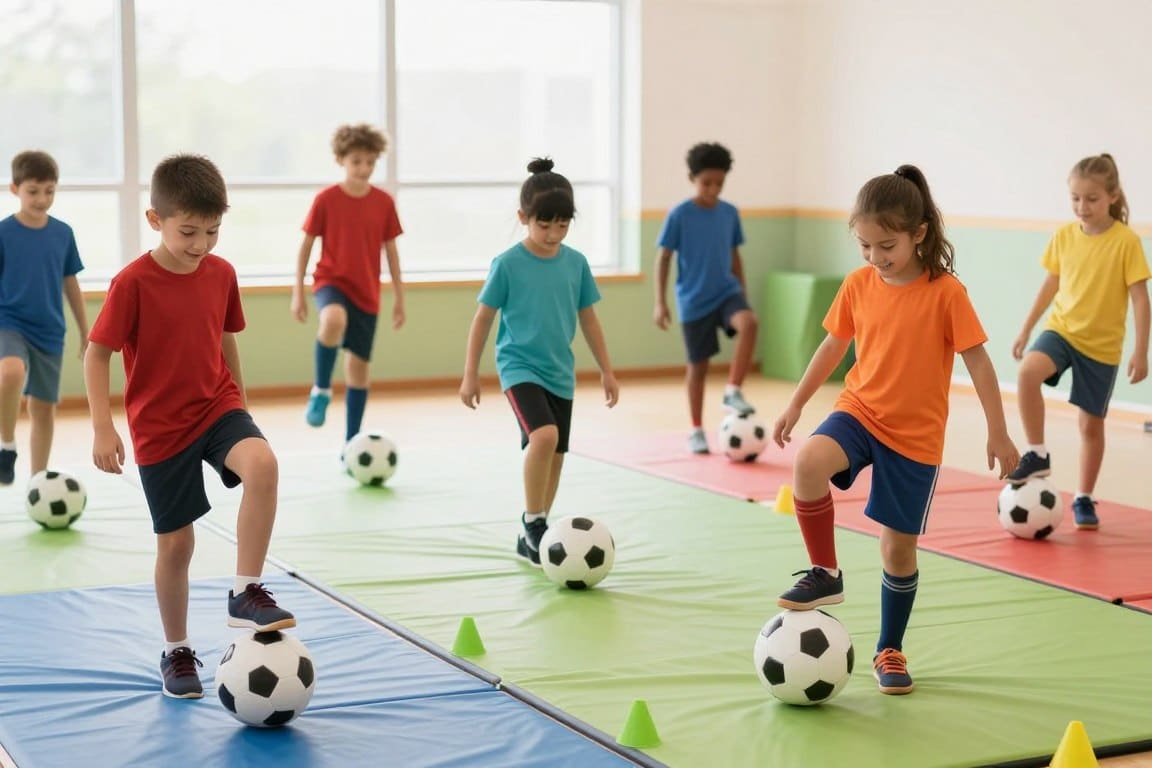
Start every session with five minutes that wake up legs and brains. I run a quick warm-up first because warm muscles cut slips and bumps indoors.
Dynamic movement warm-up
Quick sequence: high knees (20 sec), butt kicks (20 sec), side shuffles (20 sec), hip circles (10 sec each side). Keep moves in place so players stay safe.
Add a short ball warm-up next. Have each child tap the ball between feet, then do soft toe touches for 30 seconds. This gets touch and confidence fast.
If space allows, stair climbing is a great indoor cardio option—two runs up and down at an easy pace builds endurance without heavy impact.
Yoga and stretching for recovery
On low-energy days I use gentle yoga and stretches. Try child’s pose, low lunges, and hamstring reaches. Hold each move 20–30 seconds.
Include single-leg balance holds with the ball to train balance and body control. Finish every warm-up with one calm breath cue so the next activity starts focused.
- Keep it short: five minutes keeps attention and makes steady progress.
- Adjust intensity: high-energy or recovery—same routine, different pace.
- Mind the weather: bad weather doesn’t stop training when you have a simple way to move.
| Warm-up | Time | Primary benefit |
|---|---|---|
| Dynamic moves | 3 min | Warm muscles, cardio |
| Ball touches | 1 min | First touch, confidence |
| Yoga/stretch | 1 min | Recovery, balance |
fun soccer fitness games for rainy days kids can play inside
With a little tape and a soft ball, you can run five quick activities that build touch, balance, and stamina. Each setup takes minutes and fits tight space. Keep rules short and scores simple so play stays pressure-free.
Keep-up ladder: touch, balance, and focus
Set levels: 5, 10, 15 touches. Count aloud. Move up a level when the child succeeds.
Progression: use only the weaker foot or bounce the ball once between touches.
Wall pass challenge: first touch and accuracy
Tape a small target box on the wall. Pass and control the rebound.
Rule: one touch to control, second to return. Score by hitting the box three times.
Balloon soccer volleyball for younger ages
Replace the ball with a balloon to slow play and build confidence. Keep hands off—use feet, thighs, or chest.
Play short rounds. Celebrate simple wins to keep it upbeat and safe.
Living room obstacle dribble course
Use cups or shoes as cones. Dribble around each marker, then sprint to the line.
Time each run or count clean touches. Swap feet to add a small challenge.
Red light, green light dribbling game
Call “green” to dribble and “red” to stop quickly. Add “yellow” for slow touches.
Keep rounds short—best of three or beat your own score. This trains quick stops and starts with low risk.
- Quick set-up: soft ball, tape, common household items.
- Simple scoring: best of 3 or personal best.
- Easy progressions: use other foot, smaller target, or timed runs.
| Activity | Main skill | Adjust |
|---|---|---|
| Keep-up ladder | Touch & balance | Change touch count or foot |
| Wall pass | First touch & accuracy | Tape smaller box |
| Balloon volleyball | Coordination & confidence | Use balloon or soft ball |
| Obstacle dribble | Control & cardio | More markers or timed runs |
| Red/Green dribble | Stops & quick starts | Add penalties or rounds |
Indoor soccer tennis games with a taped line or mini net
Turn a taped line or a mini net into a lively indoor court that builds touch and teamwork. This setup needs little equipment and fits a small indoor field easily.
Solo wall rally
Stand a few feet from a wall. Kick or volley the ball against the wall and control the rebound.
Goal: keep a steady rally of 10 touches. This trains first touch and decision speed.
Two-player one-bounce match
Mark a center line with tape or use a mini net. Players may use any body part except hands.
Allow one bounce and up to three touches per side. Score when the other player cannot return.
Keep rounds short—first to 10 wins. Let beginners use two bounces to build confidence.
Four-player doubles for teamwork
Play 2v2 on the same small court. Teams call one clear word like “mine” to avoid collisions.
Tip: keep the court tight and limit sprints. This keeps play safe and focused on skills.
- You set up with tape or a mini net—no fancy equipment needed.
- Start solo, move to one-bounce singles, then to doubles to grow team play.
- Adjust bounces and touches for younger players so everyone feels successful.
| Format | Main focus | Beginner tweak |
|---|---|---|
| Solo rally | First touch, control | Short target (5–10 touches) |
| One-bounce singles | Decision speed, accuracy | Allow two bounces |
| 2v2 doubles | Team communication, positioning | Smaller court, clear calls |
Target practice games that build shooting accuracy
Small, steady shots at marked targets teach kids how to aim without risking the house. I keep setups soft and low so players can learn form and control.
Sock-ball corner targets with safe shots
Use sock-balls in corners or taped boxes on a wall. Soft shots protect walls and lamps. Place two to four targets and keep shots low and controlled.
Point-based shooting rounds for teams
Split kids into teams and run short rounds. Each hit earns points—one for outer targets, three for the small center box.
- Rotate shooters fast so waiting time is short.
- Keep a simple score chart on paper so everyone sees progress.
- Use one coaching cue—like “plant foot next to the ball”—to focus skill development.
Timed accuracy challenge for older kids
Set a short clock—30–60 seconds—and let players score as many target hits as possible. This teaches focus under pressure without heavy power shots.
End with a bonus target round where a tricky target gives extra points. It keeps the mood light and ends practice on a high note.
| Drill | Setup | Main benefit |
|---|---|---|
| Sock-ball corners | 2–4 soft targets, low shots | Safe aim & controlled striking |
| Point rounds | Teams, paper score chart | Engagement & teamwork |
| Timed challenge | 30–60s clock, fixed distance | Focus under pressure |
| Bonus target | Small high-value box | Motivation & confidence |
Looking for more simple activities that keep kids active? Try this short list of tag-style drills to add variety.
Team ball control games for passing and first touch
Gather a few players and mark a small ring. This circle pass and move setup fits tight spaces and keeps everyone active.
Why it works: team control games improve first touch and quick decision-making. Teams learn to share responsibility while players get steady touches and simple training cues.
Circle pass and move game
Form a circle with 4–8 players. One ball starts in the middle or with a player. Use one clear rule: pass, then move to a new spot. This stops standing still and keeps the rhythm steady.
Two-touch passing rule
Limit touches to two: control then pass. That speeds play and sharpens first touch. Keep the pace friendly so beginners do not feel rushed.
Communication rule that builds teamwork
Ask players to call the name of the teammate they pass to. This simple cue grows trust and helps teams move as one.
- Praise effort: reward trying, not perfection.
- Quick reset: collect the ball and restart after a short pause.
- Benefit: a great way to build touch, confidence, and basic soccer skills.
| Format | Players | Main focus |
|---|---|---|
| Circle pass | 4–8 | First touch & movement |
| Two-touch | 4–8 | Speed & decision-making |
| Named pass | 4–8 | Communication & teamwork |
Footwork and agility games for speed and fitness
You can boost agility at home with just tape, a ball, and a little imagination. I like short drills that fit into small rooms and still build speed, coordination, and stamina.
Agility ladder drills using painter’s tape
Make a ladder on the floor with painter’s tape. Use two patterns: straight rungs and diagonal steps. Run each pattern for 20–30 seconds, rest 20, then repeat three rounds.
Quick-feet cone taps for cardio
Set up two small markers and tap each cone with the foot as many times as possible in 20 seconds. Count taps aloud. Rest and repeat three times. Turn it into a friendly game to keep players engaged.
Stair stepping intervals for endurance
If you have stairs, do 30 seconds up-and-down, 30 seconds rest. Repeat five rounds. Keep one person on the stairs at a time and clear the landing to stay safe.
Balance holds with the ball for core strength
Have kids stand on one leg while holding a soft ball at chest height. Hold 10–20 seconds, switch legs. This builds core support and better control with the ball.
- Quick tip: use painter’s tape as low-cost equipment that won’t harm floors.
- Keep drills short so attention stays high and effort feels achievable.
- Finish with a slow walk and a water break to lower heart rate the right way.
| Drill | Time | Main benefit |
|---|---|---|
| Tape ladder | 20–30s rounds | Speed & coordination |
| Quick-feet taps | 20s intervals | Cardio & quick touch |
| Stair intervals | 30s on/off | Endurance & leg strength |
| Balance holds | 10–20s each leg | Core & balance |
How to adjust indoor soccer games by age and skill
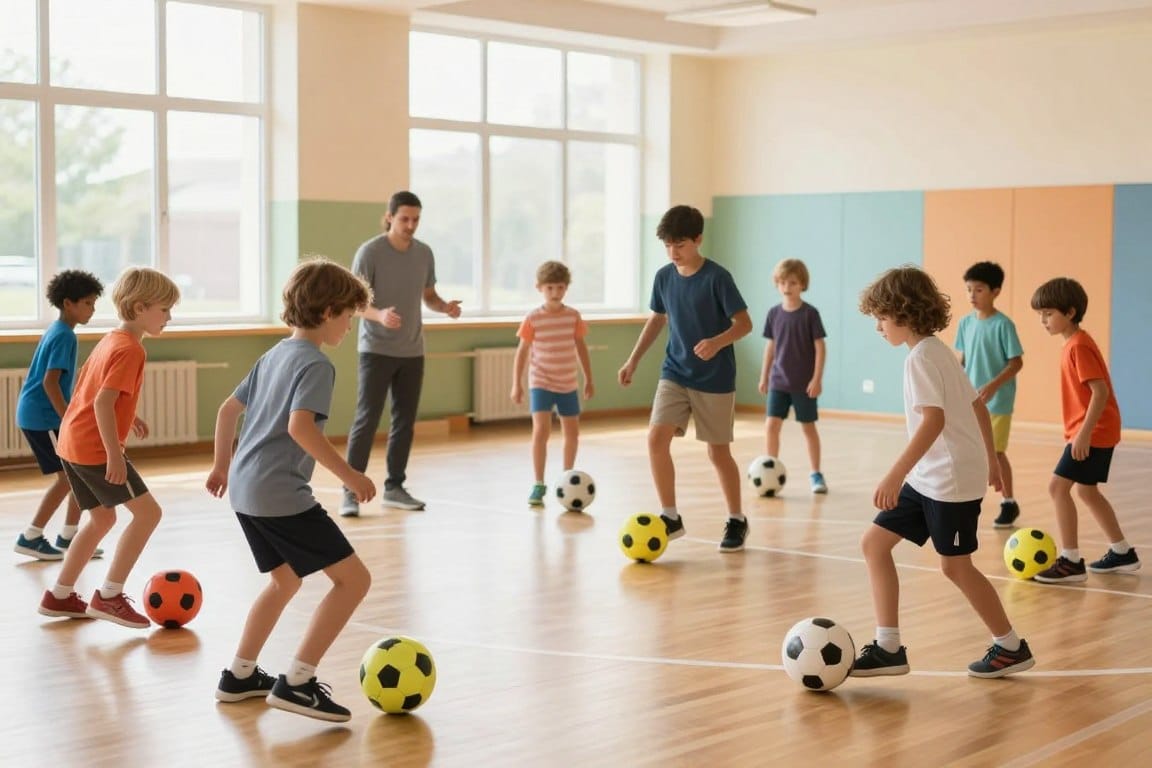
A few simple changes can make the same drill perfect for a preschooler or a club player. Match challenge to the child’s age so practice stays positive and short. I keep rules clear and roles simple to avoid meltdowns.
Easy options for preschool and early elementary kids
Keep it simple: bigger targets, slower balls, and short rounds. Use two bounces in soccer tennis or allow hand help for very young players.
Give clear start/stop cues. That structure helps early elementary kids stay focused and enjoy each short time of play.
Skill progressions for older kids and club players
Make drills harder with small changes: weaker-foot only, fewer touches, or smaller targets. Track personal bests to keep club players engaged without pressure.
Tip: use scores that measure effort—touch count or accuracy—not just wins.
Ways to include siblings with different skills
Give different roles so everyone helps. One child can be a timer or scorekeeper while another shoots. Change distance or bounce rules to balance mixed-ability teams.
Emphasize effort over result. That keeps the mood light and makes practice a shared win.
- Match games to ages to cut frustration.
- Use clear cues for younger kids.
- Progressions for older players: smaller targets, weaker foot, fewer touches.
- Include siblings with roles like timer, target setter, or referee.
| Age group | Rule tweaks | Role ideas |
|---|---|---|
| Preschool (ages 3–5) | Bigger targets, slower ball, 30–60s rounds | Helper, target setter |
| Early elementary (6–8) | Clear start/stop cues, two-touch limits | Timer, scorekeeper |
| Older players (9–12+) | Weaker-foot only, smaller targets, timed bests | Coach assistant, challenger |
Conclusion
Short indoor sessions can deliver touch, passing, and cardio without a field or fancy equipment. When weather keeps you inside, a clear plan helps players stay active and learning.
Quick wins: pick one game for touch, one for passing, and one activity for fitness. Use soft equipment and one safe space so play stays calm and low risk.
Rotate kids through short rounds. Set one hands rule and one boundary each day. That keeps rough play down and energy high.
Try it today: set a 15-minute block after homework, pick three drills, and watch training carry over to real play. Small steps add up—indoors can still build real skills.