
Reactive Speed Training Tips for Kids

Reactive speed training for kids helps young players win the first step and feel confident on the field. I believe kids learn best when they play, jump, and race in fun drills that mimic real game moments.
This guide shows simple, safe drills you can run at home, in a yard, or on a field with basic cones. Coach Tyler Germain and Overtime Athletes both stress starting with basic movement before adding advanced patterns.
You will get short sessions, playful games, and clear gear checks—space, shoes, cones, and a ball. I promise no pressure, no punishment runs, and lots of play. You will also preview easy drills like ball drops and wave cues that link quick feet to real play.
Key Takeaways
- Play-based drills build agility and confidence.
- Start with basic movement before complex patterns.
- Sessions should be short, safe, and fun.
- Basic gear: space, shoes, cones, and a ball.
- Drills connect quick reactions to real game wins.
What reactive speed means for kids in sports
Kids get an edge when they learn to respond the instant they see or hear a cue. I define this simply: you see or hear a cue, then you move fast right away. This is reaction made useful in play.
Compare that to straight-line sprinting. In a sprint the path and goal do not change. You run one direction at top pace. In real games, the cue can change the path in a flash.
Why quick reaction matters in soccer, basketball, and field sports
In soccer you chase loose balls and step into space. In basketball you grab rebounds and cut on defense. In field sports a quick read helps you stop and change direction without falling. Reaction time wins small battles in every match.
What “good” looks like by age
- Age 4–7: steady balance and basic moves. Focus on coordination.
- Age 8–10: cleaner cuts, faster first step, fewer stumbles.
- Age 11–12: quicker choices and sharper agility in play.
| Age | Signs | Practice focus |
|---|---|---|
| 4–7 | Balance, fewer falls, basic control | Simple games, coordination drills |
| 8–10 | Faster first step, cleaner cuts | Short cues, light direction changes |
| 11–12 | Quicker choices, game-like reads | Small-sided play, cue-based drills |
Safety basics for youth speed training
A simple checklist of surface, space, and shoes makes sessions calmer and safer for young players. I keep rules short so you can run drills without worry.
Choose safe surfaces, space, and shoes
Pick flat grass, turf, or a clean driveway with no gravel. Make lanes clear and keep other children out of the line. Use shoes that fit snugly, have good grip, and no slippery soles.
Use simple rules for landing and stopping
Teach two landing rules: land soft and land under control. Teach one stopping rule: take extra small steps to slow down instead of slamming the brakes.
Stop signs that mean you should end a drill
If a child has sharp pain, dizziness, limping, or repeated sloppy landings — stop. Also stop if form falls apart or if a child asks for a break. Rest time is part of good practice; keep reps crisp by spacing them out.
- Do not let kids dive to make up for a slow reaction — no diving in ball-drop activities.
- Watch feet and foot placement when landing to protect the body.
- Keep fun as the goal — safety helps children learn faster and enjoy activities more.
| Aspect | What to pick | Why |
|---|---|---|
| Surface | Flat grass or turf | Even ground lowers trip risk |
| Shoes | Snug, grippy sole | Better control on turns |
| Space | Clear lanes | Safe movement and less collision |
Build the base first: coordination, rhythm, and body control
I start every session with simple skills that make later work safer and more useful. Stable children move faster and stay healthy. That is why base development matters.
Two stable positions: teach an “athletic stance” — knees bent, chest up — and “tall posture” for jumps and landings. These give kids a reliable start and safer landings.
Use skips, hops, and shuffles
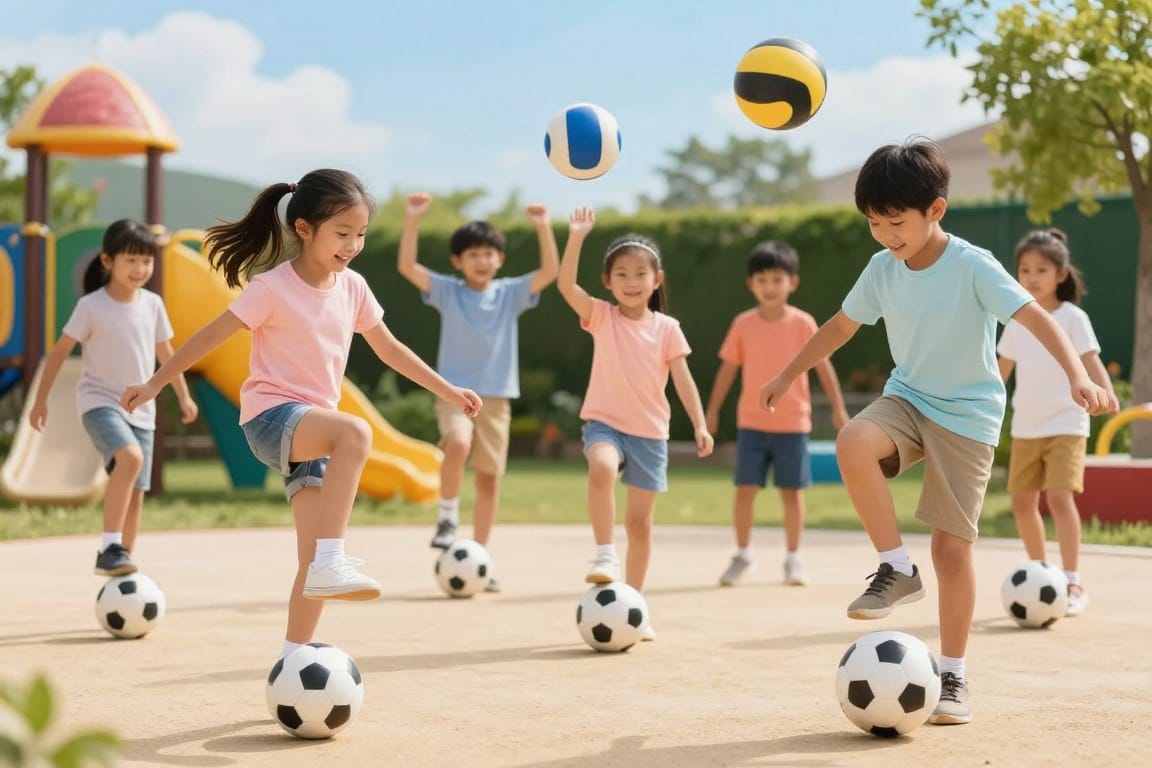
Keep drills short and playful. Use skips, pogos, shuffles, and marching to build coordination and elastic strength. One clear cue per drill helps: “stay tall,” “soft land,” “quick feet.”
Keep coaching cues short and clear
Talk less. Show more. Give one cue, then let them try. Kids tune out long speeches — short cues keep focus and fun.
- Why it works: rhythm links to better cuts and quicker first steps in games.
- Scaling: slow the movement or shorten the range when control drops.
Mini-circuit example
- 20 seconds marching (cue: “tall posture”)
- 20 seconds skips (cue: “bounce light”)
- 20 seconds shuffle (cue: “quick feet”)
- Repeat 2–3 times — total 5–8 minutes
| Focus | Move | Coaching cue |
|---|---|---|
| Posture & landing | Tall posture | “Chest up, soft land” |
| Coordination | Skips & pogos | “Bounce light, stay tall” |
| Agility prep | Shuffles | “Quick feet, small steps” |
Foundational plyometrics that improve quick feet and fast ground contact
Begin with playful plyometrics that help children get off the ground faster and land safely. These short drills teach timing, balance, and elastic strength without pressure.
Multi-directional pogos
Step: small bounces on both feet, move a few steps each way.
Cue: “small hops, stay tall.” Goal: quick contacts and ankle stiffness.
Skater hops
Step: leap side-to-side, land on one foot, hold briefly.
Cue: “stick the landing.” Focus: lateral power and single-leg balance.
Power skips
Step: skip for height and distance, drive the knee up, push hard into the ground.
Cue: “big push, soft land.” This builds force and strength for better jumps.
Single-leg hops
Step: short hops on one leg with steady rhythm.
Cue: “knee over toe, quiet land.” Work on alignment and control.
Multi-hurdle jumps
Step: use mini hurdles first, then raise slightly as form stays good.
Cue: “flow over, land light.” This links rhythm to real game movements.
- Sets: 2–4 short bursts with full rest.
- Fixes: reduce jump size, slow tempo, or use two feet if form drops.
- Play cues: “quiet landings” and “beat your best rhythm.”
| Drill | Main focus | Quick cue |
|---|---|---|
| Multi-directional pogos | Ankle timing | “small hops” |
| Skater hops | Lateral balance | “stick the landing” |
| Power skips | Force into ground | “big push” |
Set up your space with cones and simple markers
C simple cone layouts make practice fast and calm. You only need flat ground, a few markers, and a clear plan. I keep setups short so you can start play quickly and keep children engaged.
Easy cone layouts for a driveway, yard, or field
Three quick builds (60 seconds):
- Two-cone lane — straight sprint or backpedal.
- Five-yard shuffle box — small lateral drills.
- Short zig line — quick cuts and change of directions.
How far apart cones should be for young players
Use simple distances: 5 yards for shuffles and ball drills, 10 yards for quick-change drills, and up to 20 yards for longer runs. Scale down by half for ages 3–6.
These ranges come from common youth setups and keep work safe while still useful.
How to run a drill line with more than one child
One child goes, one waits behind the start cone. Keep at least one big step of side space on each lane so children do not crash into each other.
Coaches should stand where every child can see the visual cue — usually behind the start cone or slightly to the side.
| Layout | Best use | Distance |
|---|---|---|
| Two-cone lane | Runs, backpedals | 10–20 yards |
| Shuffle box | Lateral quickness | 5 yards square |
| Zig line | Cutting and change | 5–10 yards gaps |
No cones? Use shoes, water bottles, or chalk as markers. Keep set up calm and part of the program — quick swaps and simple activities keep focus high and fun first.
Reactive speed training for kids with coach cues
Use simple coach calls and clear lanes to make reactions natural and fun.
I will show three short drills with step-by-step cues you can use right away. Keep lanes clear and cones flat. Keep reps short so form stays good.
Reactive Gear Drill
Setup: two cones 20 yards apart. Do this: run between cones for 25–30 seconds. Then the coach calls “gear 1, 2, 3” in random order.
Gear words = kid words: gear 1 = jog, gear 2 = fast run, gear 3 = full run. Coach shouts a gear. The child adjusts immediately. Cue lines: “eyes up,” “quick steps.”
Reactive Sprint and Backpedal Drill
Setup: two cones 10 yards apart. Do this: sprint on cue, then stop rule applies.
Coach says “switch.” Child slows first, then backpedals to the start cone. Emphasize “slow then go” to protect knees. Short sets of 6–8 reps work best.
Wave Drill
Setup: two cones 10 yards apart. Do this: coach uses arm signals for forward, backpedal, or stop-and-chop.
Work 8–10 seconds per rep. Keep signals big and simple. Cue lines: “go,” “back,” “chop.” Count clean reps, not loud shouts.
- Safety tips: clear lane, flat cones, one child per lane.
- Coaching cues: “eyes up,” “quick steps,” “slow then go.”
- Progress tracking: count clean reps with good form.
| Drill | Setup | Coach cue | Work time |
|---|---|---|---|
| Reactive Gear Drill | 2 cones, 20 yards | “gear 1,2,3” (jog/fast/full) | 25–30 sec |
| Sprint & Backpedal | 2 cones, 10 yards | “switch” (slow then backpedal) | 6–8 reps short sets |
| Wave Drill | 2 cones, 10 yards | Arm signals: forward/back/stop | 8–10 sec per rep |
Want more ideas? Try a set of these and then explore other speed drills that build agility and game ability.
Ball-based reaction drills for first-step quickness and coordination
I use ball-based activities to connect the eyes, hands, and feet in game-like moments. These drills build fast first steps and better coordination while staying fun.
Ball Drops Drill
Setup: stand about 5 yards apart. The coach drops a bouncy ball from shoulder height. The athlete sprints and must catch before the second bounce.
Rule: no diving. Keep feet active and drive into the catch. Start positions: standing, one knee, belly, or three-point stance.
Shuffle Reaction Ball Drill
Setup: two cones about 5 yards apart. The coach throws to the left or right. The athlete shuffles and catches. This trains side movement and hand-eye coordination.
Keep eyes on the ball. Cue: “quick feet — soft land.” Count clean catches in short sets to keep focus.
Ways to scale without losing form
- Increase distance or throw speed to add challenge.
- Add a second ball and call a color or number to force a choice.
- Change start positions or limit work time to short bursts (8–20 seconds).
| Drill | Setup | Key rule | Scaling |
|---|---|---|---|
| Ball Drops Drill | Coach & athlete, 5 yards | Catch before 2nd bounce; no diving | More distance; varied starts; two balls |
| Shuffle Reaction Drill | Two cones, ~5 yards | Shuffle to catch; keep chest up | Widen cones; faster throws; color calls |
| Progress Game | Short sets, score clean catches | Keep reps short to protect form | Increase rounds or add light competition |
Form checkpoints: chest up, knees soft, quiet landings, and steady foot placement. Short reps keep athletes sharp and build lasting ability.
Make reactive training feel like play so kids stay engaged
Turn drills into short games so children ask to play again. I keep rules tiny and the aim simple: fun, safe effort, and clear cues that teach quick starts and clean stops.
Red Light, Green Light to teach quick starts and stops
Play this in a flat space. One leader calls “green” to sprint and “red” to stop. Use claps or colored cards as signals.
Why it works: It trains acceleration, braking, and attention in a playful way.
Follow-the-leader for varied movement
One child leads short patterns—shuffles, small jumps, quick turns. Others copy the moves.
This adds variety and builds balance while kids imitate a peer. Swap leaders often to keep it fair.
Short races and timing games
Race to a cone or “beat your time” over 10–20 yards. Time each run with a stopwatch or phone.
Keep competition healthy: group by age or let older players run a farther lane. Praise effort, not just winning.
Simple obstacle courses that mix jumps, sprints, and balance
Use cones, a low hurdle, and a balance beam (or a line of tape). Mix two short sprints with a jump and a balance walk.
Short circuits (30–60 seconds) keep energy high and improve performance without long drills.
- I show games that kids ask to play again.
- Use claps, colors, or simple words like “go” and “stop” as signals.
- Never use running as punishment—keep play positive and encouraging.
| Game | Main focus | Time |
|---|---|---|
| Red Light, Green Light | Starts & stops | 30–60 sec rounds |
| Follow-the-Leader | Movement variety & balance | 2–3 leaders per set |
| Short Races | Effort & timing | 10–20 yards |
Teach simple sprint and change-of-direction mechanics
Good running and safe cuts start with a few small, repeatable actions you can coach in one breath. I keep cues tiny so children hear, react, and repeat with confidence.
Arm action that helps speed
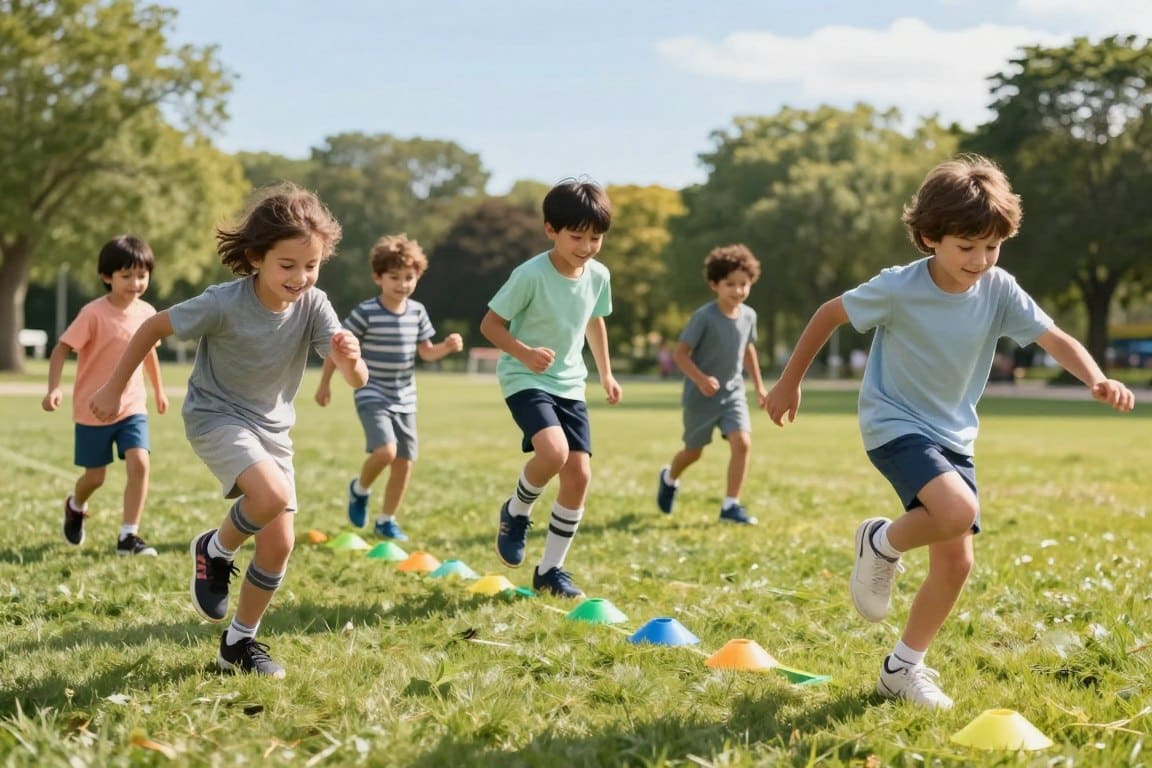
Do this: drive your arms straight forward and back. Keep hands relaxed. Do not swing arms across the chest.
- Quick cue: “pump arms, eyes forward.”
- Why: arms add rhythm and more forward force for better agility.
Foot strike and pushing into the ground
Land under your hips with the right foot placement. Push the ground away—short contact, quick rebound.
Simple cue: “land under, push off.” This improves performance and feel.
Deceleration steps that protect knees and ankles
Teach “slow in, fast out.” Lower the hips, take extra small steps, stay balanced. If a child leans forward when stopping, slow the drill.
Use one quick check: clean landings and steady body position. That keeps agility work safe and fun.
| Focus | Do this | Quick cue |
|---|---|---|
| Arms | Drive back and forth, relaxed hands | “Pump arms” |
| Feet | Land under hips, push to rebound | “Land under, push off” |
| Decel | Lower hips, take extra steps, stay balanced | “Slow in, fast out” |
Build a simple weekly program that fits youth sports schedules
I offer a short weekly plan that fits busy evenings and keeps practice fun. The aim is steady progress without long sessions or pressure.
Session length and total work time
Keep sessions 20–35 minutes. Use short bursts of work and full rest between reps.
Use drill times like 8–10 seconds for quick reps and one 25–30 second set for older groups. Count clean reps, not loud effort.
Sample structure: warm-up, drills, game, cool-down
- Warm-up (5–7 minutes): base moves and rhythm.
- Drills (8–12 minutes): one short reactive set plus one ball or change drill.
- Game (5–8 minutes): short, playful match or race.
- Cool-down (2–4 minutes): easy walking and stretch.
Progressions and where strength fits
Week 1–2: learn patterns and rhythm. Week 3–4: add direction and a little speed work.
When form stays clean, add harder cues or a longer set next week. Simple strength work helps older youth athletes stay safe.
| Week | Focus | Easy add-on |
|---|---|---|
| 1–2 | Patterns & coordination | Short reps, basic games |
| 3–4 | Elasticity & direction | More cuts, 8–10 sec reps |
| 5–8 | Mechanics & reaction | 25–30 sec gear set; light strength |
Keep it simple: track best times, clean reps, or game “wins.” Use those small marks to guide progress and protect form.
Conclusion
Finish each session with a clear next step so practice stays simple and fun. I recap what you now know: start with safe basics, build coordination, then add short reaction drills.
Pick two drills and one game. Do them once or twice each week. Keep reps short. Give full rest. Stop when a child loses form.
Starter drills: pogos, skater hops, ball drops, and Red Light / Green Light. These build better first steps and cleaner stops.
You will know it works when your young athlete starts faster, stops cleaner, and plays with more confidence. No fancy gear needed—just consistency and small wins. Celebrate progress and keep it fun!