
Fun Soccer Camp Activities for Kids to Enjoy
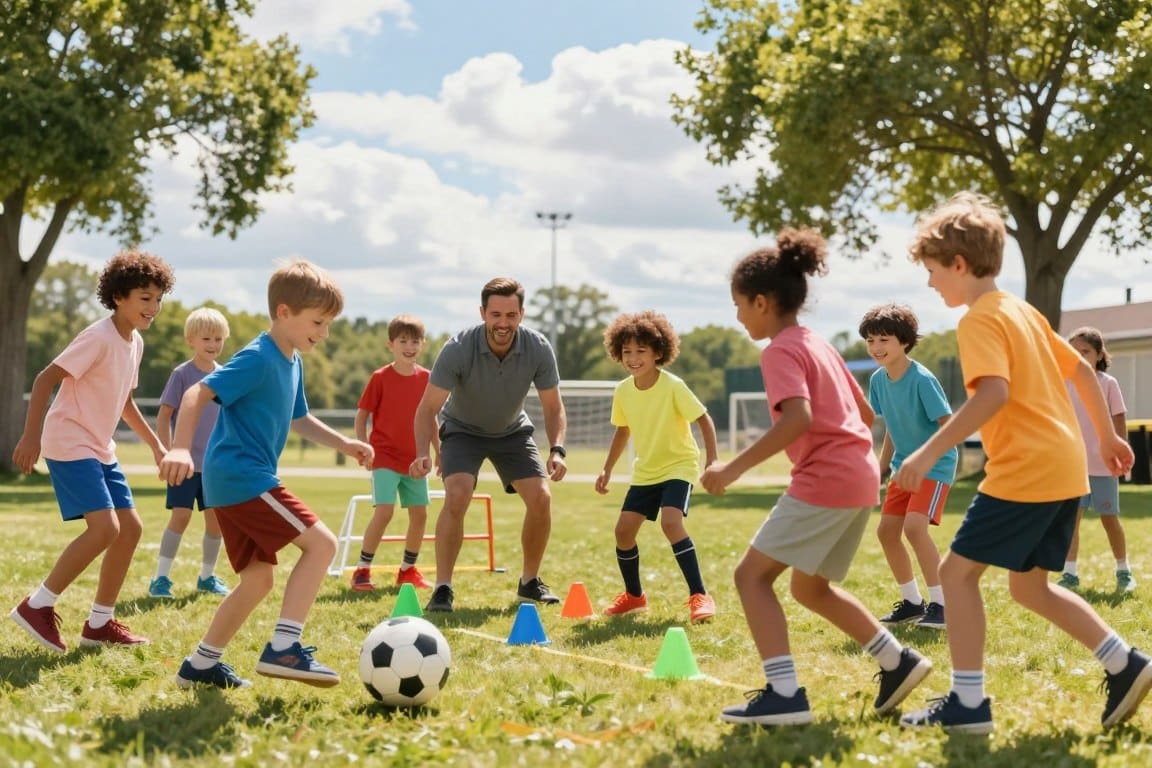
Imagine your child’s face lighting up as they master a new skill, surrounded by friends and laughter. Finding the right soccer camp activities for kids can turn a regular summer into an unforgettable adventure.
I want to share engaging ideas that make learning feel like pure play. The right program mixes skill-building with so much joy that young players don’t even realize they’re practicing.
These sessions are designed for children, typically ages 3 to 12. They focus on building fundamental skills like ball control and passing in a pressure-free environment.
You don’t need to be an expert to get it. I’ll explain how simple drills and games boost coordination, teamwork, and self-esteem. Every activity has a purpose, wrapped in fun.
Key Takeaways
- The best programs make skill development feel like an exciting game.
- These experiences can transform a child’s summer into a positive, active adventure.
- Young players learn essential fundamentals in an age-appropriate, supportive setting.
- Drills are designed to build ball control, teamwork, and personal confidence simultaneously.
- Structured practice is crafted to feel like play, keeping participants fully engaged.
- Physical fitness is woven into the experience through enjoyable challenges.
- Guidance is straightforward and accessible for all parents and beginner coaches.
Introduction to Soccer Summer Camps and Fun Activities
When school lets out, many families look for ways to keep their young ones moving and smiling. Seasonal programs fill this need perfectly. They offer a structured outlet for all that youthful energy.
These gatherings welcome participants from toddlers to pre-teens. The focus is on two big areas: physical health and social growth. Young athletes run, kick, and play in a safe, supervised setting.
Coaches teach fundamental skills like dribbling and passing through creative games. Repetitive drills are not the method here. Instead, every exercise feels like play, keeping engagement high.
Your child builds ball control without even realizing they’re practicing. The environment celebrates trying your best. This approach nurtures personal confidence alongside athletic ability.
Friendships form naturally on the field. Shared goals and teamwork create strong bonds. Many participants leave with new pals and great memories.
Benefits of Soccer Camp Activities for Kids
Beyond learning to kick a ball, participants gain lifelong advantages from these fun sessions. The positive impact touches many areas of a young athlete’s life.
I want to highlight the key areas where you’ll see growth. These benefits work together to create a fantastic experience.
Physical Fitness and Skill Development
Your child gets a full-body workout while having a blast. Running and jumping during games builds strength and endurance naturally.
They don’t feel like they are exercising. This constant movement sharply improves their coordination.
Fundamental soccer skills grow through engaging drills. Dribbling and passing practice feels like play. This repeated fun format drives real development.
Teamwork and Social Interaction
Group drills teach young players to communicate and share. Teamwork becomes a natural part of the game.
Your child learns to work toward common goals with peers. Friendships form easily over shared challenges.
This social interaction builds a sense of belonging. Kids gain confidence from being part of a team.
| Benefit | What Kids Gain | How It Happens |
|---|---|---|
| Physical Fitness | Improved strength, coordination, and stamina | Continuous movement through games and relays |
| Skill Development | Better ball control, passing, and shooting | Fun, repetitive drills disguised as play |
| Teamwork | Communication skills and shared responsibility | Group challenges and team-based games |
| Confidence Boost | Increased self-esteem and pride in achievement | Mastering new skills and celebrating small wins |
Watching a child’s pride swell after mastering a new move is powerful. That confidence carries into school and home life.
Soccer camp activities for kids
Effective youth programs are built on a mix of focused practice and playful competition. Let’s look at the two main parts that create this balance.
Essential Drills That Build Skills
Drills form the foundation. They focus on specific targets like ball control and dribbling.
I recommend using a confined space, often a 20 by 30-yard grid. This setup keeps all players active. It prevents standing in lines and waiting.
Each person gets maximum touches on the ball. This repetition builds muscle memory and confidence quickly.
Engaging Games That Encourage Fun Play
Games transform practice into excitement. There are over 235 different options designed for youth enjoyment.
Many start without a ball as a simple warm-up. Once the concept is clear, you add the ball. This method keeps the mood light and learning stress-free.
You only need basic gear like cones and discs. For great ideas, explore the best toddler soccer coordination games to.
| Activity Type | Main Purpose | Typical Setup | Best For |
|---|---|---|---|
| Essential Drills | Building core skills like dribbling & control | Small grid, one ball per player | Focused repetition |
| Engaging Games | Encouraging fun play & teamwork | Same grid, often with challenges | Applying skills in play |
Dribbling Drills to Build Ball Control
Let’s focus on two foundational drills that build essential dribbling skills in a way young athletes love. These activities combine skill-building with speed and control. They form a crucial part of any practice.
Relay Races for Speed
I always start with relay races. They mix speed, ball control, and team excitement perfectly.
Divide your group into teams in a relay line. Each child must dribble the ball around a series of cones. Then they race back to tag the next teammate.
This drill teaches participants to control the ball while moving quickly. It builds great confidence with the ball at their feet. The team aspect encourages friendly competition and cooperation.
Controlled Dribbling Exercises
These exercises focus on keeping the ball close. The goal is not to kick it far ahead.
You can set up a free dribble activity. All players move with their own ball in a confined space. The rule is simple: avoid hitting each other.
As players improve, slowly tighten the grid size. This challenges them to maintain closer ball control. I’ve found giving each player their own ball maximizes touches.
The ultimate goal is for a young player to dribble without constantly looking down. This develops a natural feel and sharp coordination. These exercises prepare them for real game situations where control under pressure matters most.
Fun Games to Improve Dribbling and Accuracy
Let’s explore two classic games that turn dribbling practice into an adventure. The best part is how these fun games build real skill while everyone is laughing.
I always recommend Shark and Minnows. One player is the shark in the center. The other players line up as minnows on one side with their ball.
Their goal is to dribble across the space without getting tagged. If the shark tags a minnow, that player joins the shark team. This fun game teaches quick thinking and sharp footwork.
Red Light/Green Light is another favorite. Each child dribbles their ball in a grid. When I call “green light,” they move slowly. “Red light” means stop the ball with your foot right away.
Kids can even make car noises while they play. This adds to the imaginative fun. It also teaches great listening skills and instant ball control.
Both games improve accuracy naturally. Players must guide the ball exactly where they want it to succeed. They get so focused on the game, they forget they’re practicing dribbling.
Interactive Warm-Up Activities for Kids
Good warm-ups do more than just get bodies moving. They prepare young minds for learning.
I always start a session with interactive fun. These beginning exercises set a positive tone.
Freeze Games to Boost Focus
I begin with Freeze games. They teach body control in a playful way.
All players run around without a ball first. The coach calls “Freeze!” Everyone stops in a funny pose.
Players look at their teammates’ silly positions. Then the coach says “Go” to restart.
Next, we play Freeze II. Each player dribbles a ball. They must stop it at their feet on the command.
This progression builds both body and ball control. It sharpens listening skills and focus.
Name Game Introductions
The Name Game helps everyone learn each other. It builds a welcoming community from the start.
Everyone sits in a circle. Each child states their first name loudly.
The coach repeats each name and says “Welcome.” This makes every participant feel valued and included.
| Activity | Primary Goal | How to Play | Key Benefit |
|---|---|---|---|
| Freeze Game | Boost focus and body control | Coach calls “Freeze!” and players stop in funny poses | Teaches quick listening and response |
| Name Game | Build community and welcome everyone | Circle where each child states name, coach repeats it | Creates a valued, inclusive atmosphere |
These simple activities prepare players physically and mentally. They ensure everyone is engaged and ready for the fun ahead.
Engaging Drills Across Different Age Groups
The secret to keeping young athletes engaged lies in tailoring the challenge to their level. I organize drills into three main age categories: U3/U4, U5/U6, and U7/U9 and older. This helps match the activity to each group’s ability.
Simple Activities for Young Players
Your youngest participants need short, clear tasks. Think chasing the coach or dribbling like a penguin.
A game like “Busy Bees” is perfect. Each child dribbles their ball and tries to tag the coach’s feet. These activities focus on basic movement and lots of encouragement.
Progressive Drills for Older Groups
Older children can handle more complexity. They work in tighter spaces at faster speeds.
You’ll introduce competitive elements and intricate rules. The beauty is that age groupings aren’t rigid. I’ve seen high school players enjoy games designed for younger groups.
The key is adjusting the grid size and the speed of the task. This ensures every player is challenged but not frustrated.
Innovative Challenges and Creative Variations
Innovative challenges are the secret ingredient to maintaining high energy and interest. They keep a program fresh by introducing new twists on familiar activities.
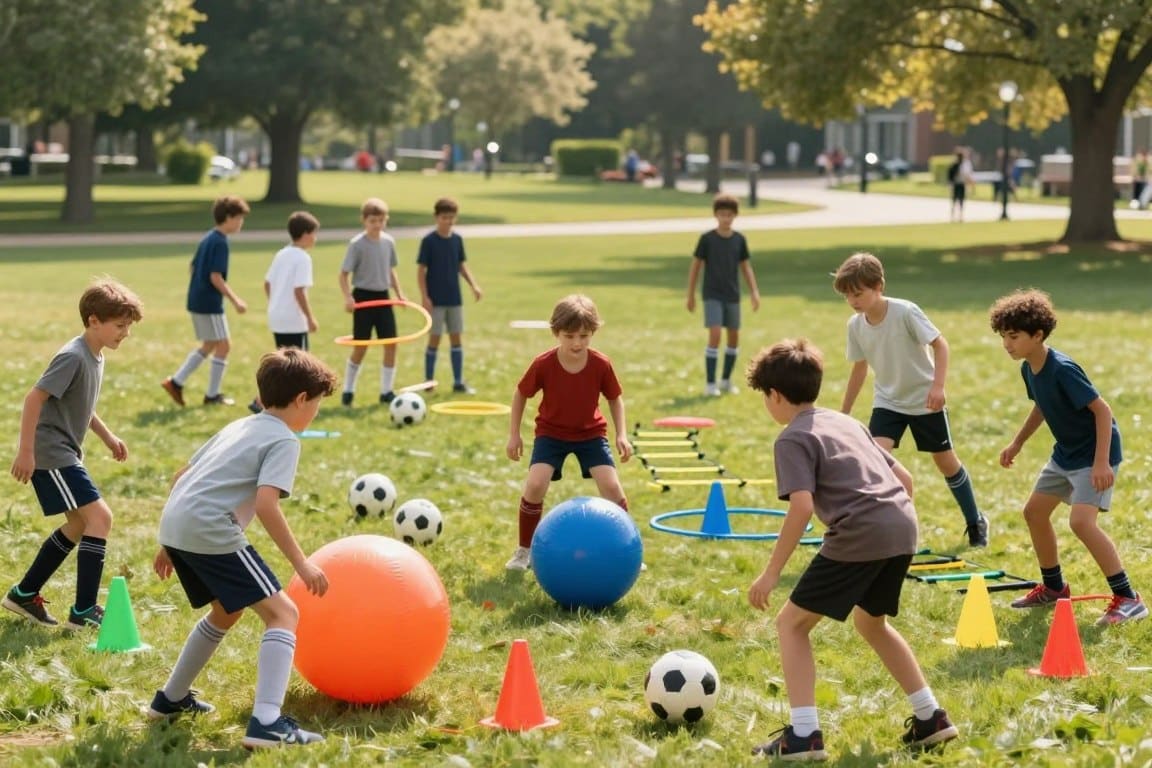
I love using the Dribble Gauntlet. You set up a zigzag course of cones. Each player must navigate it as fast as they can.
Timed challenges add a competitive element. Your child races against the clock. This motivates them to improve their speed and ball control with each attempt.
The Goalkeeper Challenge lets players experience both sides of the game. Players rotate between being the shooter and the keeper.
This variation teaches empathy for different positions. It builds multiple skills at once. Every player practices saves and shooting accuracy.
You can implement a “Skill of the Day” approach. Each session focuses on one technique, like passing or dribble control. Players participate in drills centered on that skill.
The session culminates in a fun competition. This showcases their progress. Creative variations prevent boredom and keep engagement high throughout the entire camp.
For more inspiration, check out these fun soccer games. They offer great ideas to keep your games exciting.
Team-Building Exercises That Strengthen Community
The strongest bonds on the field are often built through shared effort, not just scoring goals. I focus on exercises that teach young athletes to rely on each other.
Simple tasks like partner passing require clear communication. Two players must work together to succeed. Group challenges ask an entire team to contribute to a single goal.
These moments teach a powerful lesson. Supporting one another makes the whole group stronger. You’ll notice your child learning to encourage a struggling teammate.
This builds empathy and a true sense of community. The friendships formed here often last long after the program ends. Teams that bond well also play better together.
| Exercise Type | Primary Goal | Lasting Impact |
|---|---|---|
| Partner Passing | Build communication & trust between two players | Teaches reliance on a teammate |
| Group Challenge | Require entire team contribution for success | Fosters shared responsibility |
| Positive Cheering | Celebrate all successes, not just your own | Develops sportsmanship & empathy |
I emphasize sportsmanship in every activity. Respect and kindness matter as much as athletic skills. When players trust each other, they communicate and perform naturally.
Space-Specific Games for Field Coordination
Spatial awareness games turn a simple grid into a powerful learning tool. They teach young athletes how to use the entire field effectively.
Instead of clustering in one area, players learn to spread out. This understanding of boundaries is key for good coordination.
Grid-Based Drills
I often set up a confined rectangle for these drills. A typical grid is 20 yards by 30 yards for most age groups.
You can use cones or flat markers to mark the space. This defined area keeps all players where the coach can see them.
The grid prevents wandering and teaches spatial awareness. As skills improve, I shrink the space. This challenges close control with the ball.
The confined field forces players to look up. They must avoid others while dribbling their ball. This sharpens their vision and decision-making.
Some games work better in circles. Others need larger rectangles. The shape depends on the activity’s goal.
These exercises prepare young players for real matches. They learn about positions and organization on the pitch.
| Grid Shape | Typical Size | Best For | Key Learning |
|---|---|---|---|
| Rectangle | 20 yds x 30 yds | Dribbling & passing games | Using width and length |
| Circle | 15-20 yd diameter | Tag games & keep-away | Constant turning & awareness |
| Small Square | 10 yds x 10 yds | Advanced control drills | Tight space mastery |
Every player gets more touches on the ball in a managed space. They build confidence through repeated success.
Age-Appropriate Drills for Skill Development
You want your young athlete to feel challenged but never overwhelmed during practice. I customize drills for three-year-olds very differently than for nine-year-olds. Their skill levels and physical abilities vary dramatically.
I group players by age: U3/U4, U5/U6, and U7/U9. These groupings are not rigid. I always use the highest level of game each player can perform successfully.
Your youngest child (ages 3-4) needs fun movement and basic ball familiarity. A game like “Trees,” where they dribble around stationary adults, works perfectly. Technique is less important than joy.
Children ages 5-6 can handle more. I introduce stopping and starting on command. This builds fundamental skills in a simple way.
Your older child (ages 7-9) is ready to refine technique. I add friendly competitive elements to their skill development. The grid size gets smaller and the pace gets faster for this age group.
| Age Group | Key Focus | Sample Activity | Grid Size |
|---|---|---|---|
| U3 / U4 | Fun movement & ball familiarity | “Trees” dribbling game | 20×30 yds |
| U5 / U6 | Basic commands & control | Red Light/Green Light | 20×30 yds |
| U7 / U9+ | Technique refinement & competition | Dribble Gauntlet timed runs | 15×25 yds |
The key is matching the drill difficulty to what each age group can accomplish. Pushing too hard kills the love for the game. I want every player to experience success and build confidence at their own pace.
Creative Variations of Classic Soccer Games
Classic games become new adventures with a few creative twists. I love taking familiar activities and giving them a fresh spin. This keeps young athletes excited and engaged.
Your child already knows how to play. A simple rule change makes the experience feel brand new. This approach reinforces skills in a fun way.
Adapting Rules for More Fun
You can modify any game for extra challenge. Try using only the left foot during a dribbling drill. This builds specific control and coordination.
Adjusting the grid size is another great variation. A smaller space demands closer ball handling. Players must think faster and protect their ball.
These small adaptations keep the energy high. They prevent boredom even after multiple plays.
Innovative Game Twists
I add soccer elements to classic games like Capture the Flag. Each player must dribble a ball while trying to capture the opponent’s flag.
This twist develops strategic thinking. Your child must plan their approach and communicate with teammates.
Another favorite is adding “Yellow Light” to Red Light/Green Light. This command means slow-motion dribbling. It teaches precise ball control and listening skills.
These creative variations teach adaptability. They turn practice into a problem-solving adventure. Players learn while having pure fun.
Tips for Coaches and Parents to Run a Successful Camp
A great youth program thrives when coaches and parents work together as a supportive team. Your combined effort creates a positive environment where young players flourish.
Coaching Advice for Drills
I recommend coaches focus on keeping every player active. Avoid long lines where children wait. A low child-to-coach ratio allows for individualized attention.
All instructors are trained in child development and soccer skills. This ensures safe and effective drills. Demonstrate each activity clearly before asking kids to try it.
Your coaching approach should emphasize encouragement over perfect technique. For very young players, teach right from left before directional games. You can simply say “use your other foot.”
Challenge yourself to dream up new game variations. Start simple and add complexity only after basics are mastered.
Parental Involvement Strategies
Parents can help by volunteering as “trees” or obstacles in games. This makes them part of the fun. Your involvement shows support and builds community.
Ask families to practice simple activities at home between sessions. This reinforces skills learned. Your enthusiasm as a parent motivates young athletes.
Successful programs balance structure with flexibility. Allow time for both planned activities and spontaneous fun. Together, coaches and parents create memorable experiences.
Essential Equipment for Fun Soccer Drills
You don’t need a lot of fancy gear to run effective and fun drills for young players. I always start with the basics. Having the right equipment makes everything run smoothly and keeps the focus on playing.
First, ensure you have enough balls. Each participant should have their own ball for maximum practice. Use a size 3 ball for the youngest age groups and a size 4 for older children.
Cones are next. They create clear boundaries and mark positions for drills. This visual setup helps young athletes understand instructions quickly.
You’ll also need coaching discs or flat markers. These designate specific spots where players should stand or aim during an exercise.
For team games, pinnies or scrimmage vests are great. They help divide groups into teams instantly. Portable pop-up goals are lightweight and perfect for shooting practice.
I recommend a simple organization tip. Parents should label each ball with a permanent marker. Coaches should bring one to every session too. This prevents mix-ups and lost balls.
The right equipment isn’t complicated. With cones, discs, proper balls, and small goals, you’re set for success. Your drills will be organized, and the players will stay engaged from start to finish.
Safety First: Guidelines for a Secure Soccer Camp Environment
Creating a safe space for young athletes is the foundation of any successful program. Your child’s well-being is the top concern for every parent and coach. I focus on clear guidelines that prevent issues before they start.
A proper warm-up is the first step. I always begin each session with light jogging and dynamic movements. This prepares muscles and increases heart rate gradually.
Proper Warm-Up and Stretching
Gentle stretching follows the initial movement. Your child should participate in these routines before any intense drills. Activities like Freeze games work perfectly for this.
They get children moving without demanding maximum effort right away. This preparation is a key part of safety.
All coaches are trained in both child development and sport skills. This ensures every drill is age-appropriate and conducted effectively. A low child-to-coach ratio allows for close monitoring.
Each coach can watch fewer participants. They catch potential issues quickly. I also check the practice area for hazards like holes or debris.
Your child should wear fitted shin guards and double-knot their shoes. Coaches enforce regular water breaks, especially in heat. These steps create a secure environment for learning and fun.
| Safety Focus | Essential Action | Direct Benefit |
|---|---|---|
| Physical Preparation | Conduct a dynamic warm-up & stretching | Prevents muscle strains, prepares the body |
| Supervision | Maintain a low child-to-coach ratio | Enables quick response, individual attention |
| Environment | Inspect the practice field for hazards | Eliminates trip and fall risks |
| Proper Gear | Ensure shin guards and tied shoes are worn | Protects against impact injuries |
| Hydration | Schedule mandatory water breaks | Prevents heat-related illness |
Conclusion
As we wrap up, remember that the most successful experiences are those where children leave the field smiling and eager to return. The right program turns summer into a time for building skills and friendships through play.
Your child develops ball control, teamwork, and confidence with activities designed for fun. I’ve shared many drills and games that make learning soccer skills enjoyable.
These sessions work for three-year-olds and pre-teens alike. You now have the knowledge to choose a place that emphasizes fun, safety, and age-appropriate progression.
Look for a program that maximizes ball touches and minimizes waiting. Your young athlete deserves a summer filled with active joy and new pals.
The time spent now builds a foundation for years. The goal is helping kids fall in love with the game through positive, supportive play.